The Ukrainian rushnyk: types, meaning and wedding traditions
· Updated:

Contents
- What is a Ukrainian embroidered rushnyk?
- Types of Ukrainian rushnyky, from everyday towel to icon cloth
- Woven rushnyky: krasni, orlysti and Krolevets towels
- Embroidered rushnyky: stitches and colours by region
- What does an embroidered rushnyk symbolise?
- The wedding rushnyk: from matchmaking to the church wedding
- How many rushnyky did a girl have to embroider?
- The oldest and most remarkable rushnyky in museums
- The rushnyk today
- Frequently asked questions about the Ukrainian rushnyk
- Sources
- Regions in this article
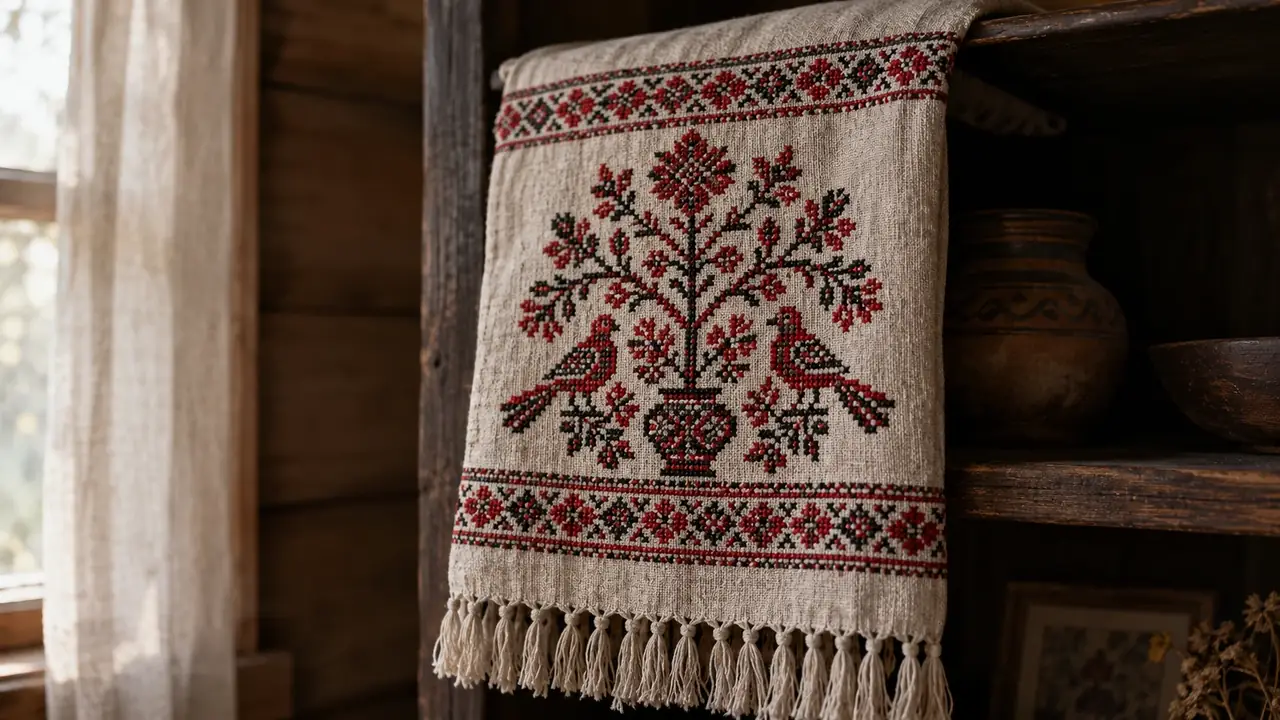
A Ukrainian rushnyk is a long strip of handwoven cloth, decorated with weaving or embroidery. Village households used it for dozens of purposes: drying hands, framing icons, greeting guests and blessing a couple at their wedding. One house might keep a plain everyday towel, while the neighbours hung a four-metre icon cloth woven with eagles. Today the embroidered rushnyk is the best-known kind, but many were woven. This guide covers the main types of Ukrainian rushnyky (the plural), what an embroidered rushnyk symbolises, how rushnyky served at a wedding and how they differ from region to region. It draws on museum collections and the field notes of ethnographers.
What is a Ukrainian embroidered rushnyk?
A Ukrainian rushnyk is a strip of homespun cloth, most often linen, decorated with embroidery, woven patterns or lace. It served at once as a household towel, a ritual object and a decoration for the home. Its purpose decided its material, its length and even its name: a coarse everyday towel was never confused with the festive one hung over icons.
The word itself covers very different things. Ethnographers who worked in villages of the Chernihiv district in 2018 recorded several local names for the rushnyk: utyrach, utyralnyk, nabozhnyk, krasnyi, orlystyi, krolevetskyi. Nataliia Telehei, who described these records, notes that people picked a name according to decoration and use, and that one word could cover several kinds of rushnyk.
Types of Ukrainian rushnyky, from everyday towel to icon cloth
By purpose, Ukrainian rushnyky fall into a few main groups. The table below brings together the types described in the sources we work with and the regions where they were recorded.
| Type of rushnyk | Used for | Recorded in |
|---|---|---|
| Utyrach, utyralnyk | everyday: drying hands and face; coarse cloth with a few coloured stripes at the ends | Chernihiv region |
| Nabozhnyk | hung over icons; long, 3-4 metres | Chernihiv region |
| Zaviska (curtain rushnyk) | covered the icons in the holy corner | northern Zhytomyr region |
| Wedding rushnyk | bride ransom, blessing, church ceremony, greeting the couple with bread and salt | Poltava, Kherson, Dnipropetrovsk regions |
| Church rushnyk | church services and feasts | Sumy region (from the 17th century) |
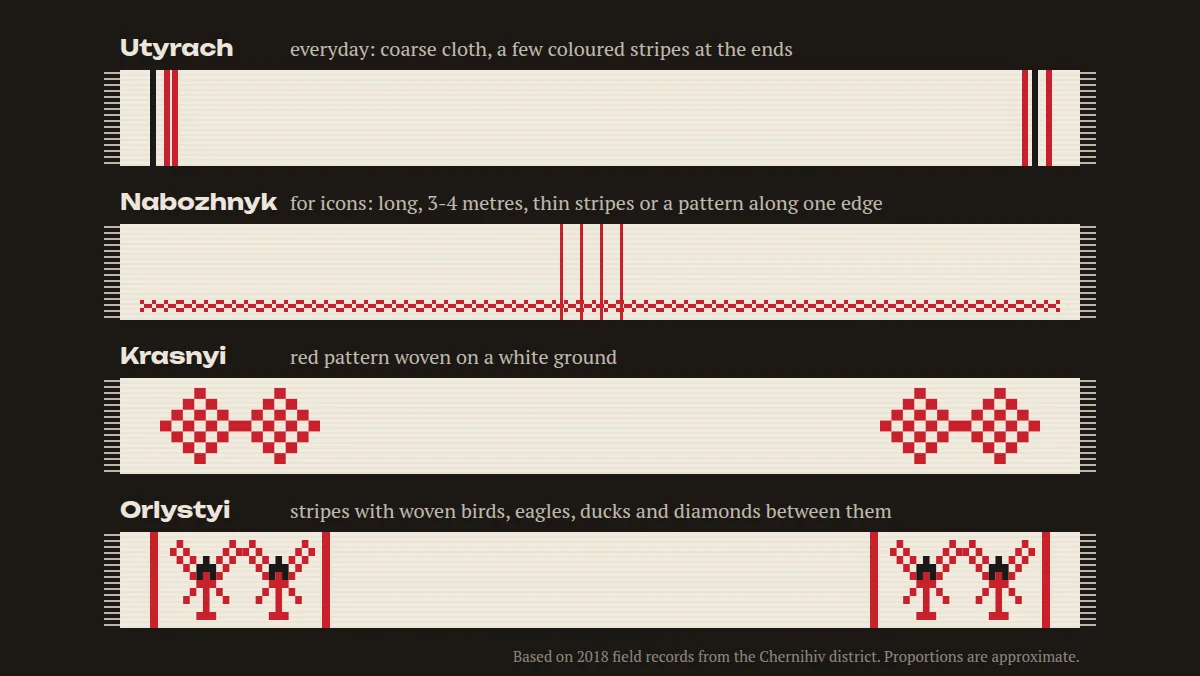
The utyrach was the simplest rushnyk. In the Chernihiv region it was woven from coarse hand-spun yarn and decorated with only a few coloured stripes at the edges. The nabozhnyk was the festive one: it was hung over icons and woven long, three to four metres, sometimes with thin stripes in the middle or a pattern along one edge.
In the north of the Zhytomyr region, around Ovruch, Narodychi and Korosten, people used curtain rushnyky. They covered the icons in the pokut, the holy corner of the house. These towels were woven from flax in the 19th and early 20th centuries, and they show that a rushnyk belonged to everyday home life.
Woven rushnyky: krasni, orlysti and Krolevets towels
Not every Ukrainian rushnyk is embroidered. Many were woven, and a woven pattern was valued as much as stitching. In the Chernihiv district, according to the expedition records, a towel with a red pattern woven on a white ground was called krasnyi, "the beautiful one". A woman from the village of Dniprovske explained it simply: red woven on white, and that is all.
An orlystyi rushnyk was woven from the same threads, but besides stripes it carried birds, eagles and ducks, flowers, leaves, diamonds, squares and zigzags. Such towels were also hung over icons, so the orlysti rushnyky count as icon cloths too. The pattern was copied from an old rushnyk to a new one by counting threads, which villagers in Drutske called real cleverness.
Krolevets rushnyky stand apart: wide red bands with birds or stylised plants between them. They were made in the town of Krolevets, but, according to Telehei, they spread across a large part of Ukraine, and villages in the Chernihiv region bought them. Krolevets overshot weaving is on the National List of Elements of the Intangible Cultural Heritage of Ukraine under number 002.нкс (order of 14 December 2012, No. 1521).
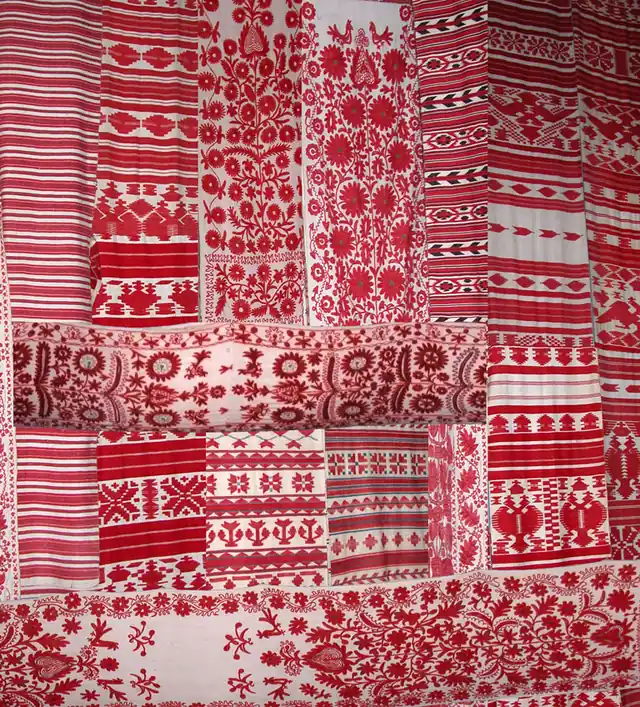
Bright shop-bought red threads often ran, so weavers boiled them in a bark solution. In the village of Ladynka people remembered shaving alder bark and steaming it to make the dye. The threads turned darker, closer to burgundy, and the rushnyk looked more restrained.
Embroidered rushnyky: stitches and colours by region
An embroidered rushnyk had its own character in each region. In the Poltava region towels were stitched mostly in red, with traditional rushnyk stitches such as proso, kachalochka and cross-filled zasypka, sometimes with touches of blue. In the old Katerynoslav province, today's Dnipropetrovsk region, the oldest rushnyky from the late 18th and early 19th centuries are, according to Z. Maryna's study, embroidered in a single colour, hand-spun red, and less often in red with light blue.
Over time the embroidered rushnyk grew more colourful. T. Kara-Vasylieva, cited by Maryna, observed that the Dnipropetrovsk rushnyk differs from the Poltava one by adding black and yellow to red. Its main subject is a tree of life growing from a vase, with doves, roosters, peacocks, ducks and often double-headed eagles on and above its branches.
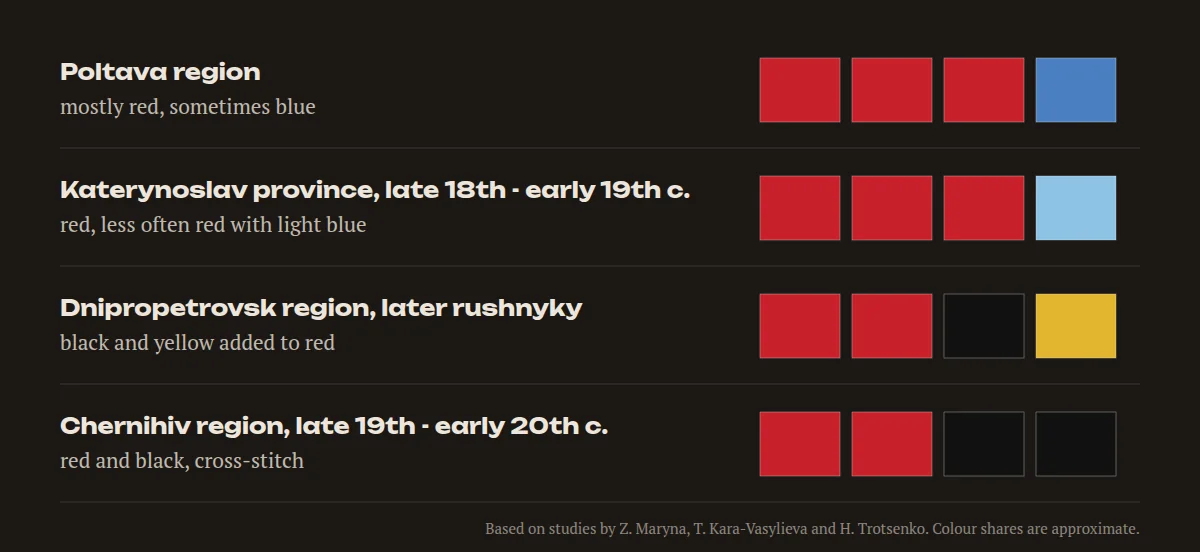
In the Chernihiv region, embroidered rushnyky of the late 19th and early 20th centuries are typically worked in cross-stitch with red and black threads, writes Hanna Trotsenko. Their motifs include human figures, birds, roosters, roses, poppies, viburnum, grapes, vases and even embroidered lines of verse. The same red and black cross-stitch patterns, known locally as tsatsky, spread to Chernihiv region vyshyvankas at the time.
An embroidered rushnyk takes a long time. Nataliia Babenko, an embroiderer from Sumy, told Suspilne that a vyshyvanka of medium difficulty takes about a month, while a rushnyk takes from six months to two years. Technique changes the look as well: tambour stitch, valued in the Sumy region and around Chernihiv, gives a towel a noticeably different style.
What does an embroidered rushnyk symbolise?
The motif seen most often on an embroidered rushnyk is the tree of life, and researchers read a tree growing from a vase as "woman as vase", a symbol of the mother and the continuation of the family.
These meanings come from researchers' readings and from the rites themselves, not from a "dictionary of symbols". In the Kharkiv region, says Olha Soshnikova, curator of the Slobozhanskyi Kod project, the roots of the tree on rushnyky often grow from a vase. On Dnipropetrovsk rushnyky the tree is surrounded by doves, roosters and peacocks.
Birds on a wedding rushnyk, according to a tradition recorded in the Donetsk region, wished the young family happiness. And the rule against embroidering living creatures on the towel the couple stood on shows that people took the pattern seriously: it was not to be trodden on.
In the 20th century the rushnyk also became a symbol of a mother's love through a song. "The Song of the Rushnyk", with words by Andrii Malyshko and music by Platon Maiboroda, was written for the film Lita molodii (1958). Its line about the embroidered rushnyk a mother gives her son "for happiness, for good fortune" is widely known, and the song is most closely tied to Dmytro Hnatiuk's performance.
The wedding rushnyk: from matchmaking to the church wedding
The wedding rushnyk was a working object of the ceremony, from matchmaking to the church wedding. In the Poltava region the bride's ransom was handed over on a rushnyk, and parents blessed the couple on special towels. The newlyweds were met from church with bread and salt on them, and during the church ceremony a rushnyk bound the couple's hands. Rites differed even between neighbouring villages, but the wedding rushnyk stayed at the centre everywhere.
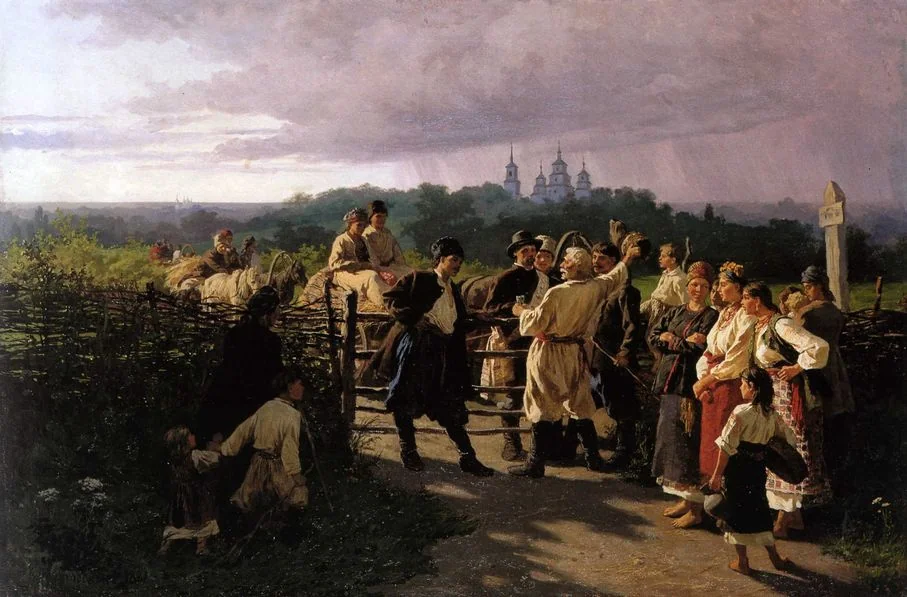
Giving the rushnyky: saying yes at the matchmaking
In many places the matchmaking itself was simply called "rushnyky". If the girl agreed to the marriage, she brought rushnyky out to the matchmakers and a kerchief to the groom, and the matchmakers were tied with rushnyky over the shoulder. Hence the Ukrainian idiom "to give the rushnyky", meaning to agree to marry.
The rushnyk under the couple's feet and "to step onto the rushnyk"
During the church wedding the couple stood on a rushnyk, so the towel laid under their feet was embroidered by special rules. In the Kherson region it carried no living creatures, only ornament: stepping on something alive was not acceptable. A widespread belief says that whichever of the two steps onto the rushnyk first will head the family. The idiom "to step onto the rushnyk" comes from this custom and means to get married.
The rushnyk for the wedding loaf and for icons
The rushnyk for the korovai, the wedding loaf, or for bread and salt is the one on which, as in the Poltava region, the newlyweds were met from church with bread and salt. Rushnyky for the icons at a church wedding are festive, like the nabozhnyky at home: they framed the icon. In the Dnipropetrovsk region, Maryna names a band of drawn-thread work, merezhka, 40-45 centimetres wide as a mark of the wedding rushnyk.
In the Chernihiv district a wedding rushnyk from the village of Voznesenske, embroidered in 1938, has survived. It shows a woman carrying water on a yoke and lines about Natalka Poltavka, in just two colours, red and black. The researcher calls this pairing a signature of the area.
How many rushnyky did a girl have to embroider?
There was no single number: according to oral tradition, a girl in the Poltava region had to embroider 15 or 20 rushnyky, in the Luhansk region at least 12 before the engagement, and in the Kherson region as many as 40.
Girls prepared rushnyky for their wedding over many years. In the Poltava region people judged by them, as by Poltava vyshyvankas, whether a girl was ready for adult life. No documents record these numbers; they come only from oral tradition.
Because of the workload, girls started early. In the Luhansk region, by tradition, they began learning embroidery before school age, or they would never finish in time. If one rushnyk took six months to two years, twenty of them meant years of work.
The oldest and most remarkable rushnyky in museums
The oldest dated Ukrainian rushnyk in the Chernihiv Tarnovsky Historical Museum carries an inscription with the year 1746. It is made of homespun linen and embroidered in white thread with counted satin stitch, cutwork, merezhka and stapivka, in a geometric pattern of diamonds. Researcher Vira Zaichenko used this collection to compile the first complete catalogue of a museum's embroidered rushnyky in Ukraine: 520 items, arranged by the districts of the Chernihiv region. Zaichenko's rushnyk catalogue is available in the museum-digital online database.
Some museums are devoted entirely to the rushnyk. In Pereiaslav, the Museum of the Ukrainian Rushnyk, part of the Pereiaslav reserve, occupies the Church of the Three Saints, built in 1651. It shows woven, block-printed and embroidered rushnyky of the Middle Dnipro area from the 19th and 20th centuries. In the settlement of Stepne in the Poltava region, a district rushnyk museum is built around the rushnyk as a ritual object rather than around clothing.
The Vasyl Krychevsky Poltava Local History Museum keeps the "Rushnyk of the Poltava Family", woven from cloth made by Yevdokiia Yakhno of Velyki Budyshcha. The art museum in Zaporizhzhia has a collection of 44 Petrykivka rushnyky gathered in the 1970s.
The rushnyk was not equally old everywhere. In the Yavoriv area of the Lviv region, embroidery went mainly onto clothing, and embroidered rushnyky only entered Yavoriv homes around 1920.
The rushnyk today
Old rushnyky still turn up in chests and attics. The Baba Yelka ethnolab in Kropyvnytskyi has gathered more than 150 embroidered towels on its expeditions. Valentyna Halkina from the village of Velyka Fosnia in the Zhytomyr region has spent more than 14 years rescuing old rushnyky and shirts. Some of them she took straight from rubbish heaps.
During the war, rushnyky have also become memory that people save. In the Kharkiv region a soldier carried century-old vyshyvankas and rushnyky out of a destroyed school museum under shelling. In Zaporizhzhia, an exhibition showed towels that Nadiia Tkachenko embroidered after the full-scale invasion began. A towel once made for a wedding is now also something people carry out from under shelling.
Frequently asked questions about the Ukrainian rushnyk
What types of rushnyky are there?
By purpose: the utyrach for everyday use, the nabozhnyk for icons, the curtain rushnyk, and wedding and church rushnyky. By technique: woven (in the Chernihiv region called krasni, orlysti or Krolevets towels) and embroidered. The same rushnyk could have several names depending on the village.
What does an embroidered rushnyk symbolise?
It depends on the pattern and the rite. Researchers in the Kharkiv region read the tree of life growing from a vase as a symbol of the mother and the family line, and birds on a wedding rushnyk traditionally wished the couple happiness. After "The Song of the Rushnyk" by Andrii Malyshko and Platon Maiboroda, the rushnyk also came to stand for a mother's love.
What does "to step onto the rushnyk" mean?
To get married. During a church wedding the couple stood on a wedding rushnyk, and the idiom grew from this custom. A related phrase, "to give the rushnyky", means to agree to marry: at the matchmaking the girl brought rushnyky out to the matchmakers.
Which rushnyk is laid under the couple's feet?
A separate wedding rushnyk that the couple stands on during the church ceremony. In the Kherson region it was embroidered only with ornament, without birds or people, because stepping on living things was not acceptable. A popular belief says whoever steps on it first will head the family.
What is a Krolevets rushnyk?
A woven towel from the town of Krolevets in the Sumy region: wide red bands on a white ground with birds or stylised plants between them. These rushnyky spread across much of Ukraine, and Krolevets overshot weaving is on the National List of the Intangible Cultural Heritage of Ukraine.
Sources
- Телегей Н. Чернігівські ткані рушники: технологія виготовлення, художні особливості та функціональне призначення; Троценко Г. Народне декоративне мистецтво Чернігівського району // Народна культура Чернігівського району (традиція та сучасний стан побутування). Житомир, 2019.
- Зайченко В. Вишивка Чернігівщини. Рушники. Видавництво «Родовід».
- Маріна З. П. Українська вишивка ХІХ - початку ХХ ст. на Катеринославщині // Історія і культура Придніпров'я. 2013. Вип. 10.
- Національний перелік елементів нематеріальної культурної спадщини України: Кролевецьке переборне ткацтво, 002.нкс.
- Харківський історичний музей імені М. Ф. Сумцова, проєкт «Слобожанський код. Українська вишивка».
- Суспільне Суми, розповідь майстрині Наталії Бабенко, 2020.
If you notice a mistake, please let us know.