Lviv Oblast
◇ DocumentedContents
- Why Lviv region vyshyvankas are so different
- The Sokal shirt: black lace
- Yavoriv embroidery: from grey linen to coloured satin stitch
- Techniques of the Lviv vyshyvanka
- Colours in Lviv region vyshyvankas
- Where to see old Lviv region vyshyvankas in person
- How to tell Lviv region embroidery ornaments from their neighbours
- Lviv Oblast embroidery ornament today
- Pidhiria: the woven inserts of the Zhydachiv area
- Frequently asked questions
- Articles about this region
- Embroidery motifs
- Dominant colors
- Sources
Lviv embroidery has no single style. The best known are the Sokal shirt, with black cross-stitch and stem stitch that leaves open white linen between the motifs, and the Yavoriv shirt, with dense, raised coloured satin stitch.
One region, several completely different traditions: Lviv and its surroundings have no single vyshyvanka style.
In the north of the region they embroidered black on white so sparingly that the linen stayed almost bare. In the west, a few dozen kilometres away, they laid coloured satin stitch, dense and raised. The distance is small, the character is the opposite.
Why Lviv region vyshyvankas are so different
The region is made up of several historical lands, and each embroidered in its own way. The best-known centres are the Sokal area in the north, the Yavoriv area in the west and the Horodok area in the centre. The south reaches into Boikivshchyna, which adds yet another distinct character.
Because of this diversity, shared features are hard to pin down: Lviv vyshyvankas from different districts sometimes look as if they came from different lands. What is usually called "Lviv embroidery" almost always means one of two things: either the Sokal shirt or the Yavoriv one.
Below we look at both, because they are confused all the time.
The Sokal shirt: black lace
The Sokal shirt is found in the north of the Lviv region, as well as in the south of the Volyn region and in neighbouring parts of Poland, on both banks of the Western Bug. This is not an administrative phenomenon but a historical land, so Lviv Oblast vyshyvankas of this type also occur beyond its borders.
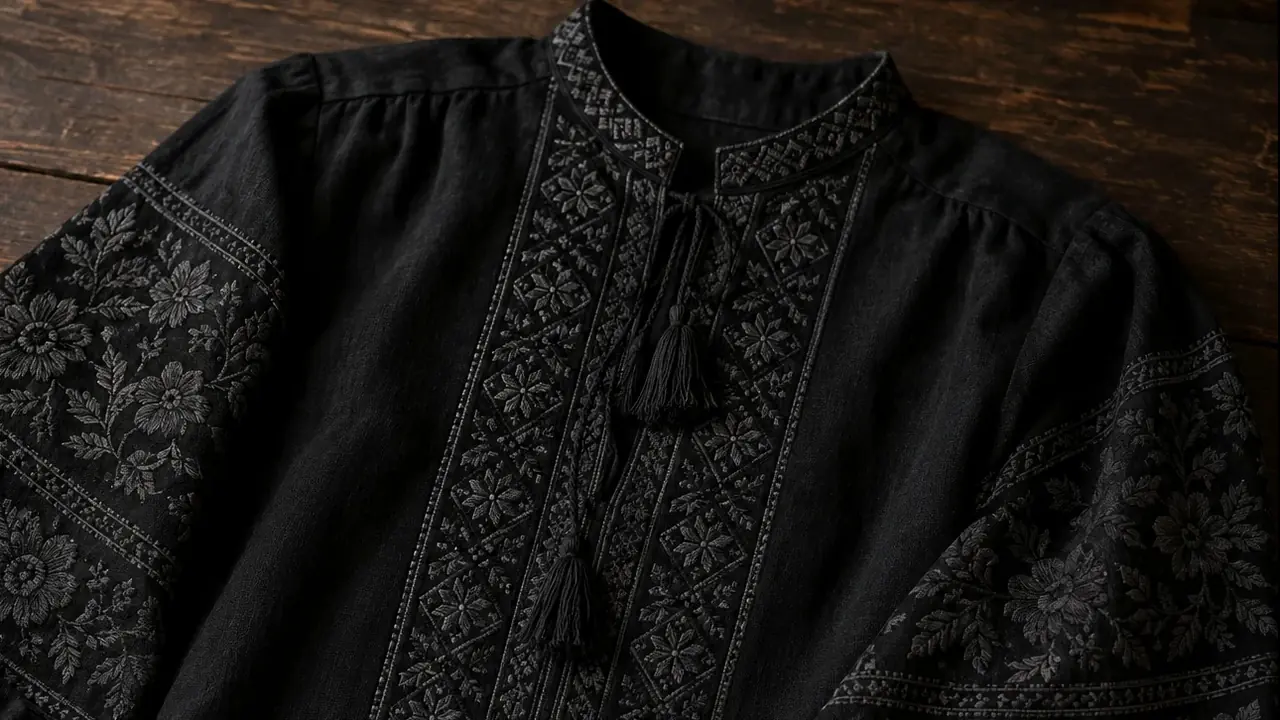
It was embroidered mostly in black thread, in cross-stitch and stebnivka. Red or yellow appeared less often, sometimes in combination, but black remained the defining colour.
The main feature by which this Lviv embroidery ornament is recognised is the bare white space between the elements of the design. Embroiderers deliberately left the surface unfilled, and as a result the dense black pattern reads as light openwork lace rather than a heavy mass. Another noticeable detail of the cut is the large turn-down collar.
At the end of the 19th century geometric ornament prevailed here. At the beginning of the 20th century plant motifs appear on the shirts more and more often: roses, tulips, periwinkle. At first these were small borders along the edges of geometric designs, later symmetrically mirrored floral compositions. The colour stayed black: the tradition changed its design, but not its main feature.
The black colour of the Sokal shirt is often linked to a tale about the burning of the town of Sokal by the Mongols and Tatars. This is a legend, not a documented reason, and it is about as widespread as a similar tale about Borshchiv embroidery in the Ternopil region.
Yavoriv embroidery: from grey linen to coloured satin stitch
The Yavoriv area produced a tradition that developed quite differently. The Lviv vyshyvanka shows this best: the history of its changes fits into a few decades, and each of them gave a different result.
In the 19th century shirts, zapasky wrap skirts and kabaty jackets were made of grey homespun linen and embroidered with waxed linen thread in white and grey. So the embroidery was almost toned into the background, without contrast. From the end of the 19th century black and red threads came into use.
At the beginning of the 20th century everything was changed by affordable factory fabric: clothes began to be made of blue or black cloth. On a dark background restraint lost its point, and embroiderers switched to yellow, blue, green and red threads, creating raised plant patterns. This period shaped Lviv embroidery ornament into the form in which it is recognised today.
Around the time of the First World War the technique changed too. Cross-stitch, which had previously prevailed, gave way to double-sided satin stitch, which in the Lviv region was called hapt. Hapt became the hallmark of Yavoriv embroidery, although historically it is not the oldest technique here.
Early Yavoriv patterns were made up of small motifs: "kryvulky" zigzags and "pupochky" dots, worked in stebnivka and cross-stitch. Later, satin stitch made it possible to draw freer plant forms.
An interesting detail of everyday life: Yavoriv embroiderers hardly ever decorated textiles for the home. Embroidery went on clothing, and embroidered rushnyky entered the Yavoriv household only around 1920.
Techniques of the Lviv vyshyvanka
At least half a dozen techniques were used within the region, and the choice depended not on the embroiderer's taste but on the type of garment: each had its own technique, its own colour scheme and its own motifs.
- Cross-stitch - the basis of the Sokal shirt, and in the Yavoriv area it prevailed until the First World War
- Stebnivka - an outline stitch that gives a thin, clean line
- Hapt (double-sided satin stitch) - the Yavoriv hallmark since the 1920s
- Kozlyk herringbone, backstitch, chain stitch - supporting stitches, often combined with satin stitch
Double-sided satin stitch deserves special attention. It means that the reverse looks almost the same as the front. This takes more thread and more precision, but the shirt has no "rough" side. This is what the most labour-intensive vyshyvanka looks like. Lviv and the Yavoriv area valued it most highly.
Colours in Lviv region vyshyvankas
There is no single palette for the region, and this follows logically from everything said above. The Sokal area keeps to black, sometimes with red or yellow. The Yavoriv area worked with white and grey in different periods, then with black and red, and from the beginning of the 20th century moved to green, orange, yellow and black at once.
So when talking about the colours of the Lviv vyshyvanka, you have to specify the centre and the century. The ornament of the early 19th and the early 20th century had a completely different colour character here.
Where to see old Lviv region vyshyvankas in person
Original pieces are kept in at least three places, and it is more than a single museum hall.
The Museum of Ethnography and Arts and Crafts on Svobody Avenue is the main address. It was created in 1951 on the basis of two large collections: the City Industrial Museum and the museum of the Shevchenko Scientific Society. Today it holds 17 collections and more than 83 thousand artefacts, of which more than 44 thousand are in the ethnography department and more than 28 thousand in the department of arts and crafts. Its collection of Ukrainian folk dress is among the largest in its holdings.
The Museum of the Shevchenko Scientific Society, opened in 1895, was historically one of the main centres for collecting folk art. It worked under the patronage of the Society's Ethnographic Commission, headed by Ivan Franko, with Fedir Vovk as deputy and Volodymyr Hnatiuk as secretary. From there much of the material later passed to the Museum of Ethnography.
The Myroslava Kot Museum-Svitlytsia in Drohobych is a completely different format. It is the home of an honoured master of folk art, which keeps more than fifty embroidered shirts as well as rushnyky, napkins and pillowcases. Part of the collection consists of replicas of old patterns from different regions, and there are old originals too. The master's students hold weekly workshops there and recreate pieces from the collection.
How to tell Lviv region embroidery ornaments from their neighbours
Western Ukraine is often seen as uniform, although four neighbouring regions behave completely differently, and vyshyvankas of the Lviv region have the most noticeable feature in this group.
- Lviv region (Sokal area) - bare white space, black cross-stitch, a lace effect
- Ternopil region (Borshchiv area) - the opposite: the sleeve is covered in black almost completely
- Ivano-Frankivsk region - geometric figures merge into one wide dynamic line, a warm autumn palette
- Chernivtsi region - diagonal stripes, silver and gold thread, beads, sequins
The simplest test by eye: look at how much linen has been left bare. If a lot, it is most likely the Sokal area. If almost none, the Borshchiv area.
Lviv Oblast embroidery ornament today
The Sokal shirt has been added to the list of intangible cultural heritage, while the Yavoriv tradition lives on through embroiderers who continue to work in the hapt technique. So the Lviv Oblast vyshyvanka remains not a museum exhibit but a living craft.
Our generator shows the ornament of one of 27 regions every day. For the Lviv region it is built from a small Yavoriv-type element with a characteristic gap between the figures. It is an interpretation, not a ready-made chart for embroidery.
Pidhiria: the woven inserts of the Zhydachiv area
South of Zhydachiv, in the villages of Chertizh, Zarichne, Volodymyrtsi, Monastyrets and Podorozhnie (now the Stryi district), women's shirts were decorated with more than embroidery. A study by Olena Nykorak and co-authors (2022) shows that in the second half of the 19th century the main decoration was a woven shoulder insert, the "ustavka", about 20 by 20 centimetres, worked in pick-up weaving with purple-red or cherry weft and a dark blue stripe across the middle. Most museum pieces come from Chertizh and Volodymyrtsi.
Later the insert was framed with plant embroidery in cross-stitch, "sosnivka" and "tsyrka", and in the first half of the 20th century embroidery gradually replaced weaving. I. Hurhula wrote about this area too: in Chertizh and neighbouring villages floral embroidery in bright colours was common on white linen and on woollen outerwear, and the catalogue of the 1936 folk embroidery exhibition praised the "mosaic flowers" of the Zhydachiv area. So some Lviv vyshyvankas continue a weaving tradition as well as an embroidery one.
Frequently asked questions
How does the Sokal shirt differ from the Yavoriv shirt?
In colour and technique. The Sokal shirt is black cross stitch and stem stitch with a lot of uncovered linen, so the pattern reads like lace. The Yavoriv shirt, from the early 20th century, is coloured satin stitch on dark factory-made cloth. These are the two types of Lviv vyshyvanka most often confused.
Why do traditions differ even between neighbouring districts?
Because the region is made up of several historical areas: Sokal, Yavoriv, Horodok and part of the Boiko land. Each developed its tradition separately, so there is no single Lviv region style.
What is the most characteristic motif?
It depends on the centre. In the Yavoriv area it is the small "kryvulky" and "pupochky", and later free plant forms in hapt. In the Sokal area it is geometric schemes, to which roses, tulips and periwinkle were added in the early 20th century.
Is the history of this tradition well researched?
On the whole, yes: western Ukrainian embroidery has been studied quite thoroughly, and museum collections hold pieces from the 19th century onwards. The Sokal and Yavoriv traditions are the best described, while smaller centres are researched much less.
What is hapt?
It is the Lviv region name for double-sided satin stitch: with this technique the reverse looks almost the same as the front. From around the First World War, hapt replaced cross stitch and became the hallmark of Yavoriv embroidery.
What is a patterned shirt from the Zhydachiv area?
A women's shirt from Pidhiria whose main decoration is a woven rather than embroidered shoulder insert with purple-red rhombuses and a dark blue stripe. At the end of the 19th century it was framed with plant embroidery, and in the first half of the 20th century embroidery gradually replaced the weaving.
If you notice a mistake, please let us know.

Gallery
Articles about this region
Embroidery motifs
The generator builds this region's vyshyvanka from these motifs, combining them differently every day. What the symbols mean
Chest and collar
Borders
- Teeth
- Kryvulka (zigzag)
Dominant colors
The main colors of this region's pattern, not a complete list of every shade found in real embroidery.
Updated:
Sources
-
Українська народна вишивка. Західні області УРСР
- Захарчук-Чугай Р.В.
(1988)
К.: Наукова думка, 1988. -
Підгірські жіночі взористі сорочки
- Никорак О., Куцир Т., Юсипчук Ю., Білий В.
(2022)
Народознавчі зошити, 2022, № 6 (168).