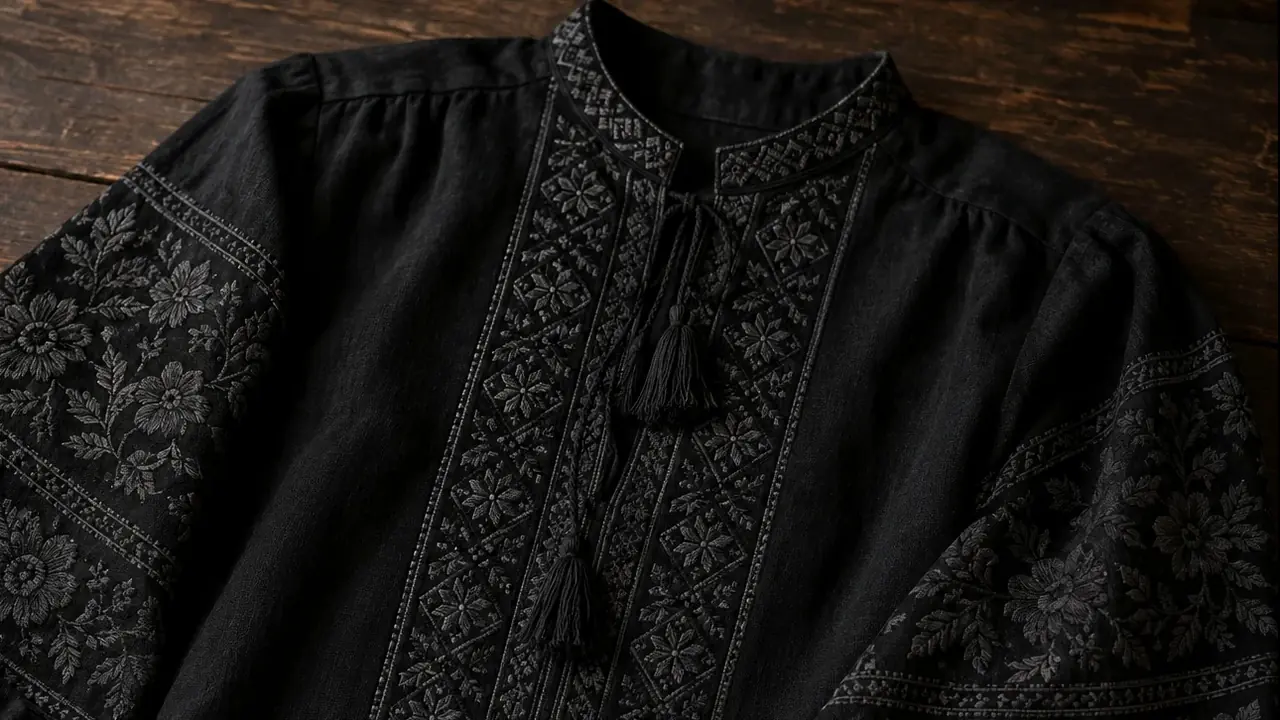
Black vyshyvanka: what black meant on a shirt, region by region
· Updated:

Contents
- What black means on a vyshyvanka
- What black meant on a vyshyvanka in each region
- The black Borshchiv vyshyvanka: facts and legend
- The Sokal shirt: black embroidery of the Lviv region
- Black nyz of Podillia
- Red and black: Brocard embroidery
- Men's and women's black vyshyvanka: does the meaning differ?
- Frequently asked questions about the black vyshyvanka
- Sources
- Regions in this article
Museums and researchers answer plainly what black means on a vyshyvanka, the Ukrainian embroidered shirt: it mostly points to the area and its dyes, not to a symbol. Meanings such as "the colour of the earth" or "mourning" they present as interpretations or folk tales. Yet in some areas a black vyshyvanka was the norm: the Borshchiv and Sokal areas, Eastern Podillia, the Khmelnytskyi region and Bukovyna.
A black vyshyvanka comes in two kinds. The first is a white linen shirt embroidered in black thread, an old tradition of several regions. The second is a shirt of black fabric with coloured embroidery, which appeared together with factory cloth in the early 20th century. How shirts differ by cut is covered in our guide to the types of vyshyvanka.
What black means on a vyshyvanka
Black on a vyshyvanka mostly meant a region: it showed where a shirt came from and which dyes the embroiderer could get. It never had one symbolic meaning for all of Ukraine.
The folklorist Volodymyr Shchybria of the Centre of Folklore and Ethnography at Kyiv University stresses that in southern Ukraine red and black "carried no separate symbolic meaning". In the Chernihiv region black thread was added to shirts rarely. According to the embroiderer Olha Kostiuchenko, it arrived there late, at the end of the 19th century, together with more accessible dyes. In Slobozhanshchyna black gradually replaced blue, because the blue dye of the time faded after washing.
Symbolic explanations exist too, but they are the readings of particular museums, not a general rule. In the piece "Sun on black linen", Vinnytsia museum staff describe a pattern on a dark ground as a symbol of the fertility of the earth. So the most honest answer to what black means on a vyshyvanka is the place where it was embroidered. We explain individual signs, such as the rhombus or the tree of life, on our page about vyshyvanka symbols, again with sources.
What black meant on a vyshyvanka in each region
Black embroidery dominated in western and west-central Ukraine: the Borshchiv and Sokal areas, Eastern Podillia, the Khmelnytskyi region and Bukovyna. The red-and-black pair spread more widely, with Brocard embroidery in the late 19th century.
| Area | How black was used |
|---|---|
| Borshchiv area (Ternopil region) | sleeve almost fully covered in black wool, motifs outlined in colour, usually red |
| Sokal area (Lviv region) | black cross-stitch and stem stitch, much bare linen, so the pattern reads like lace |
| Eastern Podillia (Vinnytsia region) | black nyz on white linen, edged in red ("pokvitnennia") |
| Khmelnytskyi region | shirts all black or all red, without mixing |
| Bukovyna (Chernivtsi region) | main palette black and burgundy, with beads and metallic thread |
| Kyiv, Kharkiv, Kirovohrad and Sumy regions | red-and-black Brocard cross-stitch from the late 19th century |
| Chernihiv and Poltava regions | black late and rare, white embroidery dominates |
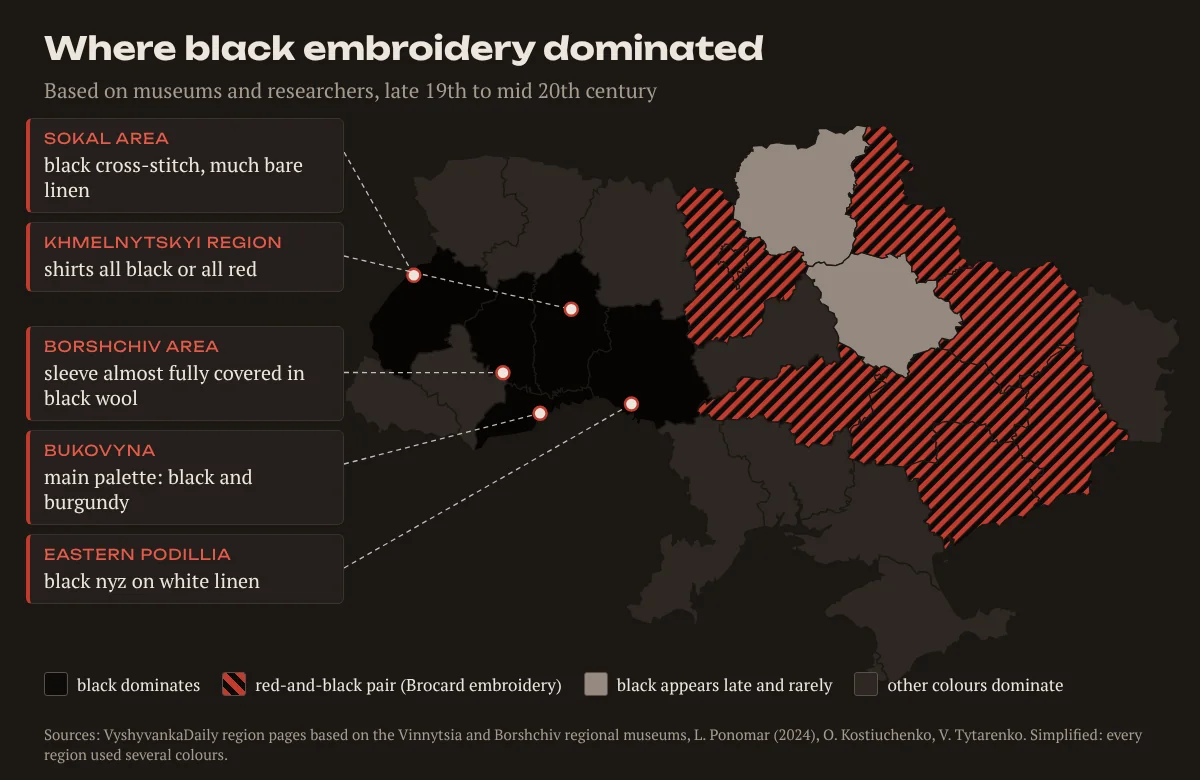
In Bukovyna a black vyshyvanka looks different from one in Podillia. The main palette of Chernivtsi vyshyvankas is black and burgundy, and the embroidery is finished with beads, sequins and metallic thread.
In the Khmelnytskyi region colours were not mixed. The most common shirts were embroidered entirely in black or entirely in red, which sets the Khmelnytskyi vyshyvanka apart from neighbouring Vinnytsia.
The black Borshchiv vyshyvanka: facts and legend
The Borshchiv vyshyvanka is Ukraine's best-known black vyshyvanka. Its sleeve is almost fully covered in black wool, and the motifs are outlined in colour, usually red.
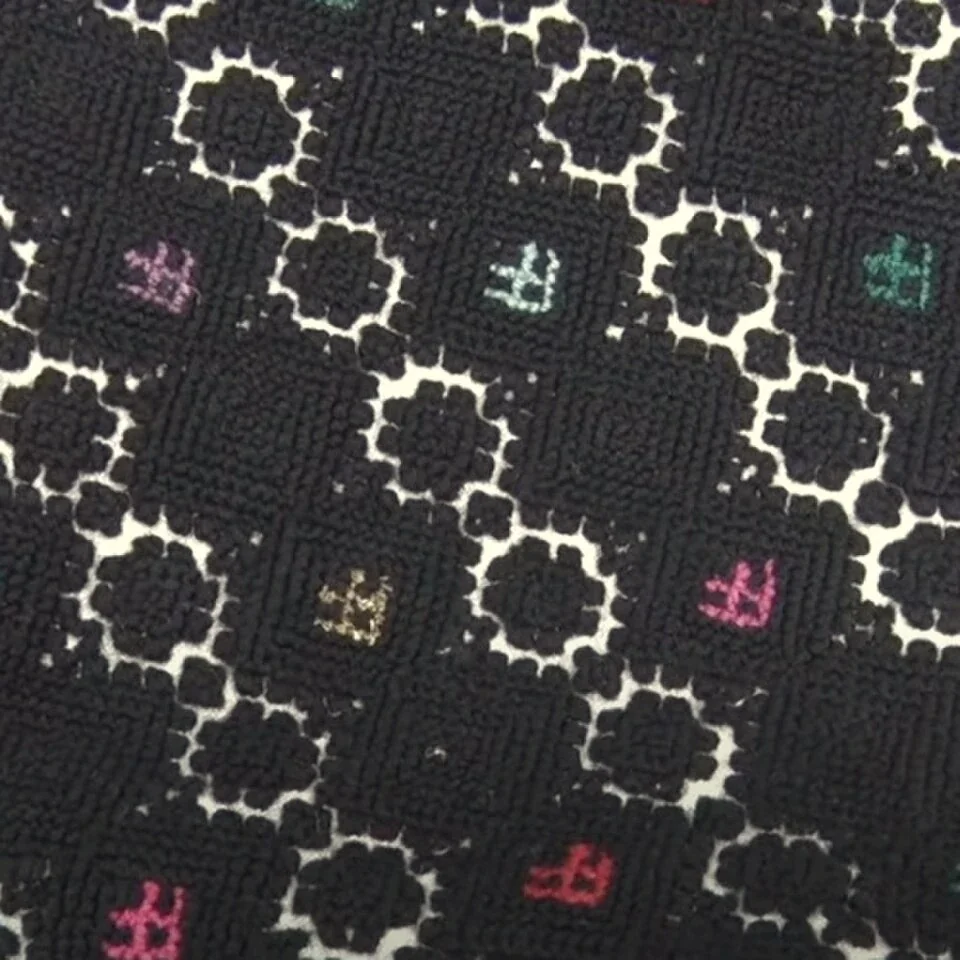
Embroiderers used wool rather than cotton. Wool is thicker and sits higher, so the sleeve looks raised. In 2020 Borshchiv folk embroidery was added to Ukraine's National List of Intangible Cultural Heritage as No. 24. The entry links it with Borshchiv, Kryvche, Melnytsia-Podilska and other villages of the area, and with communities in Lviv, Rivne, Zaporizhzhia, Kyiv and the United States that keep the tradition going.
The Borshchiv Regional Museum holds more than a hundred shirts, the oldest from the late 19th and early 20th centuries, Dzerkalo Tyzhnia reported. Shirts from Kryvche and Hermakivka are mostly floral. Those from Vyhoda, Trubchyn, Bilivtsi and Okopy are geometric and date from the 1920s and 1930s. Viktoriia Kryvonis, head of the School of the Borshchiv Folk Shirt, says that of roughly 250 embroidery techniques documented in Ukraine, more than 60 appear in the Borshchiv shirt. One shirt took about 15 years to study. An early 20th-century women's shirt from the Borshchiv community is in the Ivan Honchar Museum collection (KN-12504).
The most common legend explains what black meant on a vyshyvanka in Borshchiv: mourning for men taken by a war with the Turks. Supposedly it was to be worn for seven generations. There are several such tales, and none has direct support in the sources. What is documented is different: black really did dominate in the northern part of the area and in shirts made before the 1930s. The explanation may be more prosaic - available dyes, local fashion, the influence of neighbouring centres. The page on Ternopil vyshyvankas tells more about the Borshchiv tradition.
The Sokal shirt: black embroidery of the Lviv region
The Sokal shirt is the second well-known black vyshyvanka, but its character is the opposite of the Borshchiv one. It was embroidered mainly in black thread, in cross-stitch and stem stitch, leaving a lot of linen uncovered.
The Sokal shirt is found in the north of the Lviv region, in southern Volyn and neighbouring areas. Red or yellow thread appeared less often, sometimes combined, but black stayed the defining colour. Embroiderers deliberately left space unfilled. That is why the dense black pattern of Sokal embroidery reads as openwork lace rather than a heavy mass.
The colour of the Sokal shirt is also tied to a tale, about Sokal being burned by Mongol-Tatars. That too is a legend, not a documented cause. According to the Lviv regional administration, the Sokal shirt has been added to the National Intangible Heritage List. How other Lviv vyshyvankas differ is explained on the region page.
Black nyz of Podillia
The classic of Eastern Podillia is black nyz on white linen. Nyz is embroidered from the back of the fabric, and on the front the pattern stands out in relief, as if woven.
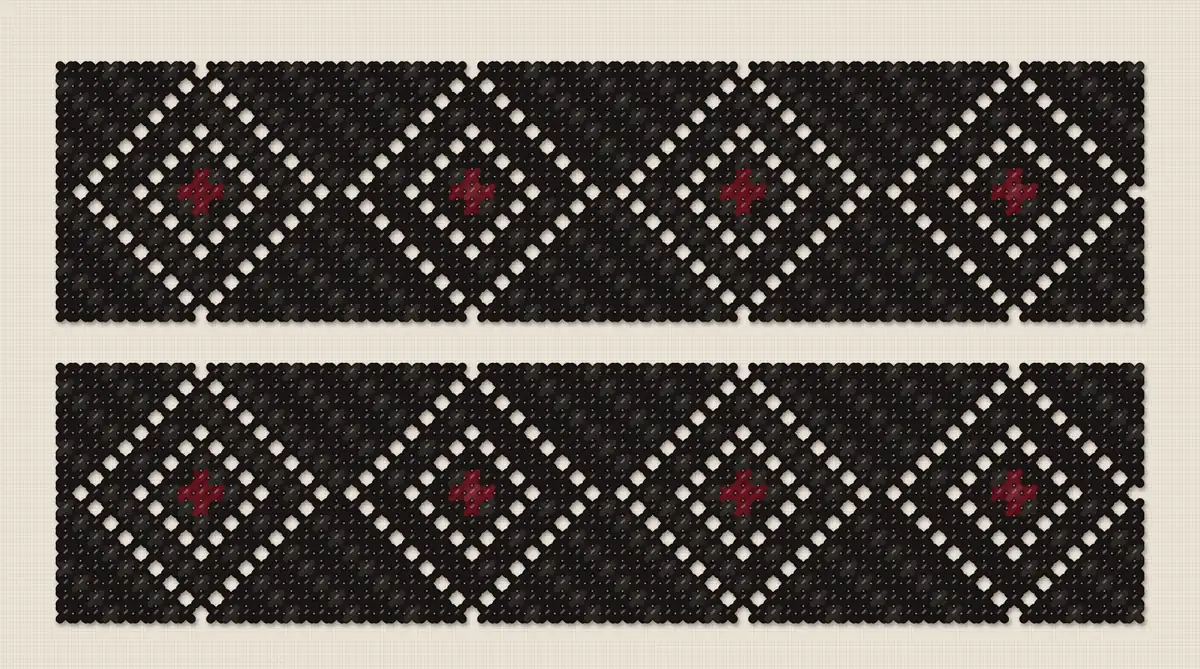
Black nyz is typical mostly of the south-western districts of the Vinnytsia region. Liliia Halchevska, a senior researcher at the Vinnytsia Regional Museum of Local History, explains that black was always dominant here, and the embroidered pattern stood out through its contrast with white linen. Black and red embroidery thread was called "zapoloch", and edging black embroidery with red, or red with black, was called "pokvitnennia".
Later came shop-bought cotton thread, and in the mid-20th century bright aniline shades. How the Podillia tradition looks today is shown by Vinnytsia vyshyvankas.
Red and black: Brocard embroidery
The red-and-black vyshyvanka most common today is relatively young. Floral patterns in red and black cross-stitch spread in the late 19th and early 20th centuries, and they are called Brocard embroidery.
The folklorist Volodymyr Shchybria explains the name: the firm Brocard and Co. gave away printed cards with cross-stitch patterns together with perfume and soap. Roses, carnations, strawberries and grapes in red and black spread across the Kyiv, Kharkiv, Kirovohrad and Sumy regions. They pushed out older local techniques. So the red-and-black pair is the youngest layer of embroidery in many regions, not its ancient base. This and other stories are collected in our list of interesting facts about the vyshyvanka.
Men's and women's black vyshyvanka: does the meaning differ?
A black vyshyvanka has no separate "men's" or "women's" meaning. Historical sources contain no rule that only men wore black shirts, and the best-known black vyshyvankas, from Borshchiv and Sokal, are mostly women's.
The traditional men's vyshyvanka was white, made of homespun linen. The ethnographer A. Pankova describes a festive men's shirt from the Chernihiv region with an embroidered chest opening, a stand-up collar and cuffs. An everyday one was sewn from grey unbleached linen. Shirts of black fabric appeared in the early 20th century, when factory cloth became available in the Lviv region. Clothing then began to be sewn from blue or black cloth, embroidered in yellow, blue, green and red.
Today's black men's vyshyvanka is mostly a shirt of black fabric with red or white embroidery. So what does black mean on a vyshyvanka of this kind? It is fashion rather than an old tradition, and it carries no hidden meaning. Our guide on what to wear with a vyshyvanka shows how to pair such a shirt.
Frequently asked questions about the black vyshyvanka
What does a black vyshyvanka mean?
A black vyshyvanka most often stands for a regional tradition, not a separate symbol. What black means on a vyshyvanka depends on the area: in the Borshchiv and Sokal areas, Podillia and Bukovyna black thread was traditional. Museums present readings such as "the colour of the earth" as interpretations, and legends about mourning as folk tales without documentary support.
What does a men's black vyshyvanka mean?
Today's men's black vyshyvanka is fashion, not an old tradition with a special meaning. Traditional men's shirts were white, with an embroidered chest opening, collar and cuffs. Shirts of black factory fabric only appeared in the early 20th century, so they carry no ancient symbolism.
What does a women's black vyshyvanka mean?
A women's black vyshyvanka is usually tied to a regional tradition rather than a separate meaning. The best-known examples are the Borshchiv shirt, with its sleeve covered in black wool, and the Sokal shirt, with openwork black embroidery. Both traditions are on Ukraine's National Intangible Heritage List.
Why is the Borshchiv vyshyvanka black?
There is no documented reason. Black dominated in the northern part of the Borshchiv area and in shirts made before the 1930s, and the embroidery was done in wool, which gave dense relief. The most common explanation, mourning for men after a war with the Turks, is a folk tale with no support in the sources.
How is the Borshchiv vyshyvanka different from the Sokal shirt?
The Borshchiv vyshyvanka is almost fully covered in black wool, and its motifs are outlined in colour, usually red. The Sokal shirt was embroidered in black thread, in cross-stitch and stem stitch, with a lot of linen left bare, so the pattern reads like openwork lace. The first comes from the Ternopil region, the second from the north of the Lviv region and southern Volyn.
Is it true that a black vyshyvanka means mourning?
No, it is a legend. Tales about mourning exist for both the Borshchiv and the Sokal shirt. None is confirmed by documents. The folklorist Volodymyr Shchybria stresses that in the south red and black "carried no separate symbolic meaning". So mourning is a folk reading of what black means on a vyshyvanka.
When did red-and-black vyshyvankas appear?
Red-and-black vyshyvankas with floral patterns spread in the late 19th and early 20th centuries. They are called Brocard embroidery: according to the folklorist Volodymyr Shchybria, the firm Brocard and Co. gave away cards with cross-stitch patterns together with perfume and soap. Roses, carnations and grapes from these cards spread across the Kyiv, Kharkiv, Kirovohrad and Sumy regions.
Where can you see old black vyshyvankas?
The largest collection of Borshchiv shirts is in the Borshchiv Regional Museum: more than a hundred shirts, the oldest from the late 19th century. Black nyz from Podillia can be seen at the Vinnytsia Regional Museum of Local History. An early 20th-century Borshchiv shirt is also in the Ivan Honchar Museum collection in Kyiv.
Sources
- Національний перелік елементів нематеріальної культурної спадщини України (Міністерство культури): № 24 «Борщівська народна вишивка».
- Музей Івана Гончара, жіноча сорочка КН-12504, Борщівська громада, початок XX ст.
- Вінницький обласний краєзнавчий музей, колекція «Вишивка Східного Поділля»; Л. Гальчевська.
- Пономар Л. Ареалогічні інтерпретації традиційного вбрання Якова Прилипка в контексті сучасних викликів. Матеріали до української етнології, 2024, вип. 23 (26).
- Панкова А. Традиційний одяговий комплекс Чернігівського району. Народна культура Чернігівського району, 2019.
- Титаренко В. П. Полтавська традиційна вишивка. Вісник НАКККіМ, 2019, № 4.
- Дзеркало тижня, Р. Якель, 14.09.2018 (Борщівський краєзнавчий музей).
- Суспільне: В. Щибря (Миколаїв, 2025), В. Кривоніс (Тернопіль, 2025), О. Костюченко (Чернігів, 2023).
- Vinnytsyanews, «Сонце на чорному полотні».
If you notice a mistake, please let us know.