Vinnytsia Oblast
◇ DocumentedContents
- Nyz: the Vinnytsia vyshyvanka stitched from the wrong side
- Why the colour is so constant
- Klembivka: a village with a double tradition
- Where to see the originals
- Vinnytsia and Khmelnytskyi regions: one Podillia, different characters
- What the symbols mean: the museum's explanation
- What Podillia called its nyz and threads
- The shirt map of the Vinnytsia region
- Frequently asked questions
- Articles about this region
- Embroidery motifs
- Dominant colors
- Sources
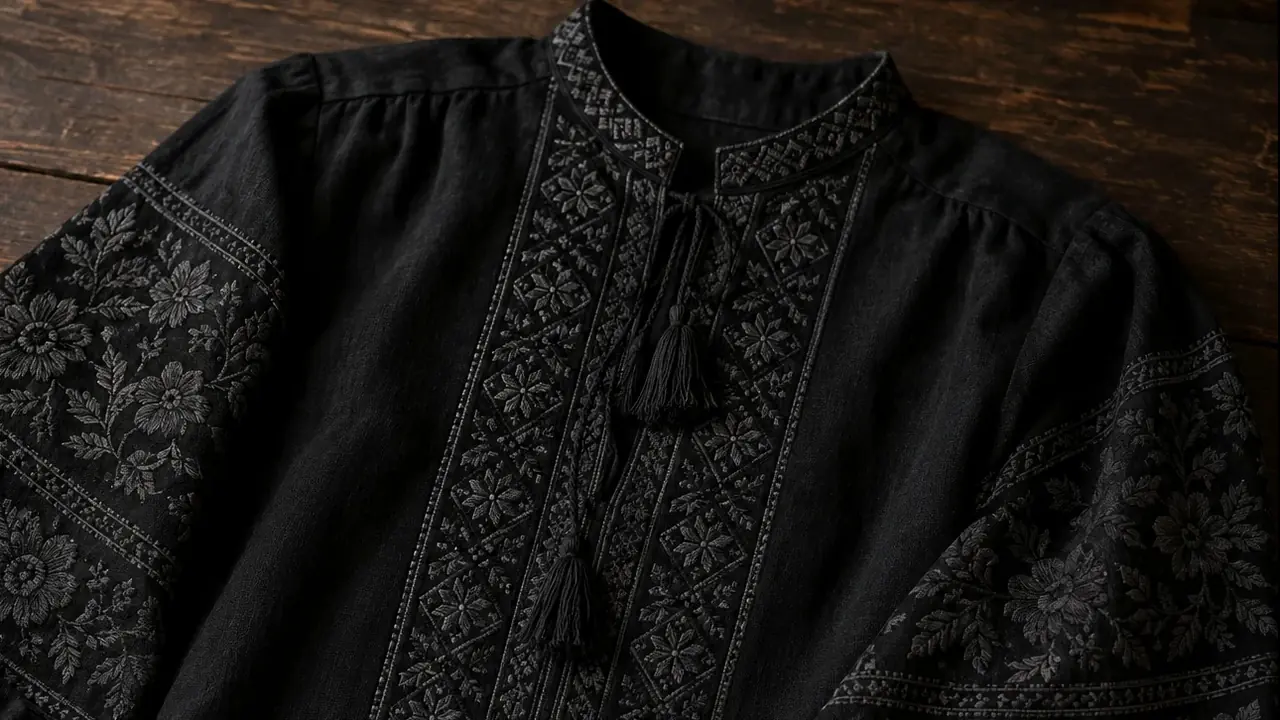
Vinnytsia embroidery is above all nyz, or nyzynka: the pattern is stitched from the back of the fabric and stands out on the front in relief, as if woven. Black nyz on white linen is the classic of Eastern Podillia, typical mostly of the region's south-western districts.
The embroiderer stitches without seeing the result. It appears only when she turns the linen over.
This is how the Vinnytsia Oblast vyshyvanka is made in its most characteristic form - with a technique that takes years to master.
Nyz: the Vinnytsia vyshyvanka stitched from the wrong side
The main technique of Eastern Podillia is called nyz, or nyzynka, and it works differently from most embroidery techniques. The pattern is stitched on the reverse of the fabric, and you can see what has appeared on the front only by turning the piece over.
The method is very old - it was already known to the Byzantines. But it was in Podillia that the pattern became an imitation of weaving: it stands out in relief against the white linen, as if woven rather than embroidered.
There are several kinds of nyz: round (elements worked as two parallel strips instead of one), bald (stitched and open areas equal in size), strapata (with characteristic teeth) and blind (with very small gaps of background). Each gives a different rhythm to what is essentially the same work.
Why the colour is so constant
Black nyz on white is a Podillia classic, typical mostly of the south-western districts of the region. According to Liliia Halchevska, senior researcher at the Vinnytsia Regional Museum of Local History, black was always dominant here, and it was this contrast that made the pattern stand out in relief.
Later, shop-bought cotton threads appeared, and in the mid-20th century the Vinnytsia vyshyvanka began to be "diluted" with touches of neon shades - embroiderers used threads coloured with aniline dyes. So even the strictest tradition let in new things over time, just slowly.
Klembivka: a village with a double tradition
In the village of Klembivka the ornamental tradition has two parts at once: patterns worked in nyz, and patterns worked in a more complex combined technique that joins up to ten methods at the same time - eyelet work, zernovyi vyvid, counted satin stitch, shtapivka and "nightingale eyes".
This is a rare case where a single village officially keeps two parallel ornamental schools rather than one.
Where to see the originals
The Vinnytsia Regional Museum of Local History has a separate permanent exhibition, "Embroidery of Eastern Podillia" - not a temporary show but a lasting part of the collection.
The Vinnytsia Regional Art Museum also holds a significant collection of folk decorative and applied art, which includes embroidery alongside weaving, ceramics, pysanky and vytynanky paper cuts. Together the two collections give a full picture of what the Vinnytsia vyshyvanka looked like in different periods.
Vinnytsia and Khmelnytskyi regions: one Podillia, different characters
Both regions are Eastern Podillia, both rely on black, but they behave differently. The Khmelnytskyi region is mostly monochrome: entirely black or entirely red shirts, with no mixing. The Vinnytsia region, by contrast, alternates colours rhythmically in squares and uses at least six techniques at once.
So the Vinnytsia vyshyvanka is more complex than its neighbour not because it is "more Podillian", but because the local tradition simply took a different path from the same basis.
What the symbols mean: the museum's explanation
For World Vyshyvanka Day the Vinnytsia Regional Art Museum held an online exhibition of women's shirts embroidered by craftswomen of the Vinnytsia region in satin stitch and cross-stitch at the beginning of the 20th century. Alongside it, the museum explained what the ornaments in its collection say.
According to this explanation, the sverha is a symbol of the solar cult, the hearth and family happiness, the vase is the tree of life, the rose is the union of the female and male principles, the cross is a sign of harmony and a protective charm, the oak is male strength, the diamond is the union of Sun and Earth and fertility, and the star is a charm against evil and illness. This is the museum's interpretation rather than the only possible reading, but it is how Vinnytsia embroidery is explained to visitors.
What Podillia called its nyz and threads
Collecting Podillian terminology, the "Local History" project lists several folk names for nyz: "parshyva nyz", "slipa" (blind), "tsvitkovana" (flowered), "nyz stitched from the front", "dribnenka" (fine). The black and red embroidery threads were called "zapoloch", and a border of red around black embroidery, or black around red, was called "pokvitnennia". The ornaments had names of their own too: "Windmills", "Cossacks", "Shtyre", "Little Apples". So the Vinnytsia vyshyvanka had its own vocabulary, passed down together with the patterns.
In a piece for the Vinnytsia Regional Centre of Folk Art, the craftsman Andrii Yermakov writes that nyz is the leading technique in the southern districts of the Vinnytsia region. He describes "lock nyz": so that the thread does not sag or catch when the shirt is worn, it is fixed to the fabric with tiny loops, "locks". The pattern is built from stitches of different lengths, so it comes out dense on the front, with long floats left on the back.
In the same place Inna Yermakova explains Podillian cutwork. It is worked in coloured threads of one or several colours, and the common "blind" cutwork is in fact not cut at all: the small squares are filled with different colours and may be finished with extra stitches. For Vinnytsia embroidery this is one more way to get an openwork effect without cutting the linen.
The shirt map of the Vinnytsia region
The Vinnytsia Regional Museum of Local History, together with the "Posydenky u Kseniky" embroiderers' club, put together the "Shirt Map of the Vinnytsia Region". Each district of the region was recreated by a separate embroiderer, in the technique typical of that district and after authentic old shirts. The map was presented on 30 July at the ethnographic event "The Wonderful World of Podillian Shirts" and handed over to the museum collection as part of the "Give the Museum an Exhibit" campaign, so the vyshyvankas of Vinnytsia and its districts can now be compared in one collection.
In the description of its collection the museum itself calls the embroidery of Eastern Podillia one of the most complex in Ukraine: ancient symbolism survives here, and alongside nyz there are poverkhnytsia, kafasor, tambour, cutwork and gold and silver embroidery. The Vinnytsia vyshyvanka shown on the museum tour "Traditional Dress of Eastern Podillia" is made up of exactly this set of techniques.
Frequently asked questions
Why is nyz embroidered from the back?
That is how the technique works: the pattern is formed by thread floats on the reverse, and the front shows a dense raised design that looks woven. So the result can only be seen by turning the fabric over.
Are Vinnytsia vyshyvankas held in museums outside the region?
Yes, Podillia nyz is represented in many Ukrainian museums, including the Ivan Honchar Museum in Kyiv. In Vinnytsia itself the regional local history museum has a permanent exhibition, "Embroidery of Eastern Podillia".
What is special about Klembivka?
Two ornament schools exist side by side in the village: plain nyz and a complex combined technique that brings together up to ten methods. Among them are cutwork, grain drawn-thread work, counted satin stitch, shtapivka and "nightingale eyes".
What does the rose mean in Podillian embroidery?
According to the Vinnytsia Regional Art Museum, the rose stands for the union of the female and male principles, which gives life to everything.
What is lock nyz?
A variety of Podillian nyz in which the thread is fixed to the fabric with tiny loops, "locks". This keeps the long stitches from sagging or catching when the shirt is worn. The craftsman Andrii Yermakov calls nyz the leading technique of the southern districts of the Vinnytsia region.
If you notice a mistake, please let us know.

Gallery
Articles about this region
Embroidery motifs
The generator builds this region's vyshyvanka from these motifs, combining them differently every day. What the symbols mean
Chest and collar
Sleeve
- Black nyz
- Curly sprig
Dominant colors
Also found
The main colors of this region's pattern, not a complete list of every shade found in real embroidery.
Updated:
Sources
-
Подільські вишивки кінця ХІХ - початку ХХ ст., зібрані Ю. Сіцинським
- Климчик О.
(1993)
// Україна, 1993, №1. Колекція Кам'янець-Подільського історичного музею-заповідника. -
Національний перелік елементів нематеріальної культурної спадщини України
- Міністерство культури та інформаційної політики України
(2023)
Борщівська народна вишивка - наказ від 13.10.2020 № 2182; вишивка «білим по білому» Решетилівки - наказ від 29.06.2017 № 561; вишивка жіночої сорочки на Гадяччині - наказ від 12.07.2023 № 380; клембівська сорочка «з квіткою» - наказ від 13.10.2020 № 2182. Орьнек - кримськотатарський орнамент та знання про нього - наказ від 12.02.2018 № 105. -
Вишивка Східного Поділля
- Вінницький обласний краєзнавчий музей
Опис колекції та екскурсії «Традиційний одяг Східного Поділля».