Poltava Oblast
◇ DocumentedContents
- Why the traditional Poltava vyshyvanka is white
- Lyshtva, cutwork and "nightingale eyes"
- Reshetylivka: the centre that gave the tradition its name
- A rushnyk that had to be one of twenty
- Colours: why there are almost none
- Where to see Poltava embroidery in person
- The Poltava region among neighbouring traditions
- Six shades of white: groups of Poltava embroidery
- The embroiderers who keep the tradition
- Frequently asked questions
- Articles about this region
- Embroidery motifs
- Dominant colors
- Sources
Poltava embroidery is above all white on white: lyshtva, cutwork and "nightingale eyes", where the pattern shows through relief rather than colour. Its best-known centre is Reshetylivka, whose white-on-white embroidery is on Ukraine's National List of Intangible Cultural Heritage.
You cannot see this embroidery from three steps away. You have to come closer and turn the shirt towards the light for the pattern to appear.
This is the Poltava vyshyvanka in its best-known form: white thread on white linen, without a single colour.
Why the traditional Poltava vyshyvanka is white
The pattern here is read not through contrasting shades but through relief. The stitches lie densely and rise above the linen, their shadows fall at an angle, and this play of light draws the ornament.
That is why the technique is considered the most difficult in Ukrainian embroidery. A coloured shirt forgives an uneven stitch: it gets lost among hundreds of others. A white one forgives nothing, because the shadow of a crooked stitch falls differently from its neighbours, and the eye notices it at once.
The thread for this work was traditionally bleached in the sun by the river. It was a long process, but without it the shade of the thread and the linen would not match, and the whole effect would be lost.
Lyshtva, cutwork and "nightingale eyes"
Poltava embroidery ornament is built not on a single technique but on a whole set of them, and each gives its own texture.
- Lyshtva - the local name for white counted satin stitch. The stitches are laid in parallel over one thread of the linen, counted as you go. The name comes from the hem of the shirt, which was once the first part to be decorated
- Vyrizuvannia (cutwork) - some threads of the linen are removed and the gaps are finished. A mistake cannot be undone: you cannot put a thread back
- Vykoliuvannia, or "nightingale eyes" - small open holes that create a lace-like effect
- Merezhka and zernovyi vyvid - openwork bands, usually along the edge of the piece
Together they achieve what satin stitch alone cannot: dense areas alternate with open ones, and the shirt looks heavy or translucent depending on where the light falls.
The order of work matters too. First the main figures are laid in satin stitch, then the joins between them are worked in slanted satin stitch, and only after that, if the pattern calls for colour, is an outline added. The sequence cannot be changed: each layer rests on the one before.
Reshetylivka: the centre that gave the tradition its name
The "white on white" embroidery technique of the village of Reshetylivka is included in Ukraine's National List of Elements of Intangible Cultural Heritage. This is not abstract recognition: behind it stand surviving pieces and living embroiderers.
Reshetylivka work is kept far beyond home. Pieces by local embroiderers are held in the National Museum of Folk Architecture and Life in Pyrohiv, the National Museum of Ukrainian Folk Decorative Art, the museum of the local art vocational lyceum, and private collections in Australia, Canada, the USA and France.
In other words, the Reshetylivka version of Poltava embroidery left the region long ago, and this happened well before any fashion for ethnic clothing.
A rushnyk that had to be one of twenty
The Poltava tradition is inseparable from the rushnyk, the ritual embroidered towel, and here numbers say more than general words.
Before her wedding a girl was expected to embroider fifteen or twenty rushnyky. Not for beauty: the rushnyk was a working object of the ritual. Matchmakers were tied with one if agreement was reached at the betrothal. The bride's ransom was presented on a rushnyk. Parents blessed the couple on special rushnyky and greeted them on the same towels with bread and salt on their return from church. During the wedding ceremony the couple's hands were bound with a rushnyk.
Rituals differed even between neighbouring villages, but the rushnyk stayed at the centre everywhere. Twenty towels meant years of work, so embroidery in the Poltava region showed whether a girl was ready for adult life.
Colours: why there are almost none
White dominates. Sometimes it is reinforced with ash grey so that the play of light reads more clearly. Red and pale blue accents do occur, but they remain the exception.
This is what defines the Poltava vyshyvanka: pattern as a phenomenon where the complexity lies not in colour but in execution. Where other regions built expressiveness on contrasting threads, here it was built on relief.
On screen this creates a problem of its own. A white ornament on a white shirt would be invisible, so our generator uses a pair of grey shades for the Poltava region. It is a compromise, and a real shirt in side light looks different from any vector reconstruction.
Where to see Poltava embroidery in person
The Vasyl Krychevskyi Poltava Local History Museum holds a significant collection of pieces embroidered in white thread, from the 19th to the early 21st century: embroidery samples, men's and women's shirts, bedspreads, tablecloths and pillowcases.
A different format is the Poltava District Rushnyk Museum in the village of Stepne. It was founded by local resident Nadiia Bokoch, and today it holds more than six hundred items. The museum is built around the rushnyk as a ritual object rather than around clothing.
The Poltava region among neighbouring traditions
White embroidery is known in other regions too, but the Poltava vyshyvanka took it to its greatest complexity.
- Sumy region - the same Poltava type, white thread and satin stitch, but multicoloured areas appear alongside
- Kherson region - also has white-on-white embroidery, although the overall character of the tradition is different
- Chernihiv region - white dominates, but the stitch is exceptionally fine, almost like beadwork
- Left-bank Kyiv region - technically closer to Poltava than to the right-bank Brocard line
The difference between them lies not in the set of techniques but in how far each region went in giving up colour. The Sumy region stopped halfway; the Poltava region went all the way.
Six shades of white: groups of Poltava embroidery
Most Poltava shirts of the 19th and early 20th century, according to Valentyna Tytarenko's study (2019), are white with added grey: unbleached thread or thread lightly dyed in ashy tones. Thread was dyed with natural dyes, oak and alder bark, elderberries and mulberries. Citing Professor Ye. Antonovych, she distinguishes groups of white embroidery: white thread only (satin stitch, eyelets, cutwork); white with motifs in ochre-brown thread that gives the ornament a golden tint; with grey, occasionally black thread; from the mid-19th century with light blue touches; from the end of the 19th century with red grain-like outlines; and the "Polubotok pattern" in blue, white and brown thread.
At the beginning of the 20th century factory-made thread brought bright colours and the contrast of red and black, but from the 1950s, according to Tytarenko, the traditional Poltava vyshyvanka returned to monochrome, now enriched with new materials. Red thread was used mostly for rushnyky, in rushnyk stitches called "proso", "kachalochka" and "zasypka khrestykom", sometimes with touches of blue.
Besides the Reshetylivka white-on-white, in 2023 the tradition and technology of embroidering the women's shirt in the Hadiach area, in the Hadiach and Petrivka-Romen communities of the Myrhorod district, was also added to the National List of Intangible Cultural Heritage. So the Poltava vyshyvanka now has two separate centres on the list.
The embroiderers who keep the tradition
Among Poltava embroiderers the researcher names Oleksandra Velykodna, Honoured Master of Folk Art of Ukraine, who over more than 30 years created about 600 shirts, tablecloths and napkins embroidered in white thread only on marquisette, batiste and silk. Vira Roik, Hero of Ukraine, mastered 300 embroidery techniques and loved Poltava rushnyk stitches most of all.
The Vasyl Krychevskyi Poltava Museum of Local History keeps the "Rushnyk of the Poltava Family", woven on cloth by Yevdokiia Yakhno from Velyki Budyshcha. And in 2012, at the "Embroidered Poltava" parade, students of the Korolenko Pedagogical University finished a rushnyk 7 metres 10 centimetres long in front of the townspeople, and it was entered in the Book of Records of Ukraine.
Frequently asked questions
Why is the shirt white rather than red and black?
Because the Poltava vyshyvanka is built on relief rather than colour: the white stitches rise above the linen, and their shadow draws the pattern. The red-and-black floral shirt is the Brocard style, which spread from the right bank of the Kyiv region at the end of the 19th century. The white tradition is older and developed separately.
What is lyshtva?
It is the Poltava name for white counted satin stitch. The stitches are laid in parallel over one thread of the linen and counted the whole time. The name comes from the shirt hem, which was once the first part to be decorated.
Did men's shirts differ from women's?
Not in technique: white embroidery was festive dress for both, and no separate men's technique is distinguished here. What differed was the cut and where on the shirt the decoration was placed.
Where can I find Poltava embroidery charts?
It is best to work from originals and specialist publications. Originals are kept, among others, by the Vasyl Krychevsky Poltava Local History Museum, and the techniques are described in detail in the works of Tetiana Kara-Vasylieva. The ornament on our site is an interpretation, not a ready-made chart to stitch from.
Is Poltava embroidery really only white?
The base is white, but with shades. Professor Ye. Antonovych, cited by Valentyna Tytarenko, distinguishes groups with ochre-brown, grey, light blue and red touches, and the "Polubotok pattern" in blue, white and brown thread. Red thread was used mostly for rushnyky.
If you notice a mistake, please let us know.

Gallery
Articles about this region
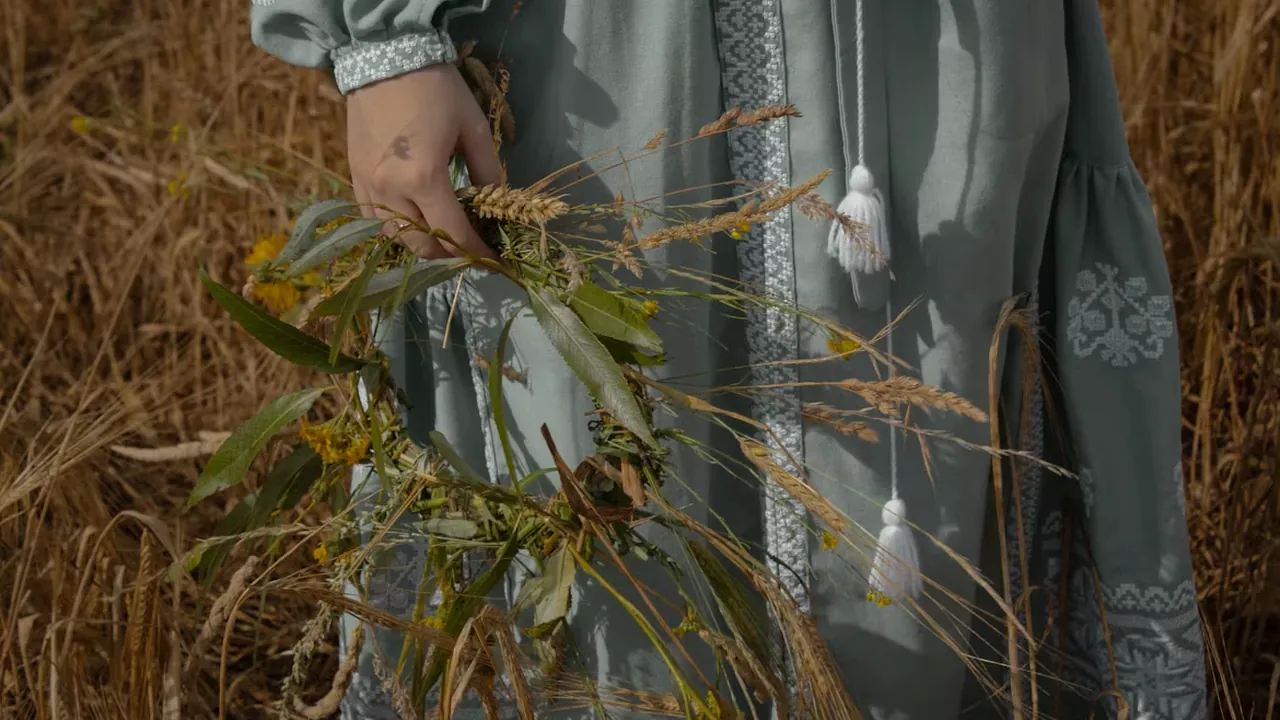
20 interesting facts about the Ukrainian vyshyvanka, plus 4 myths
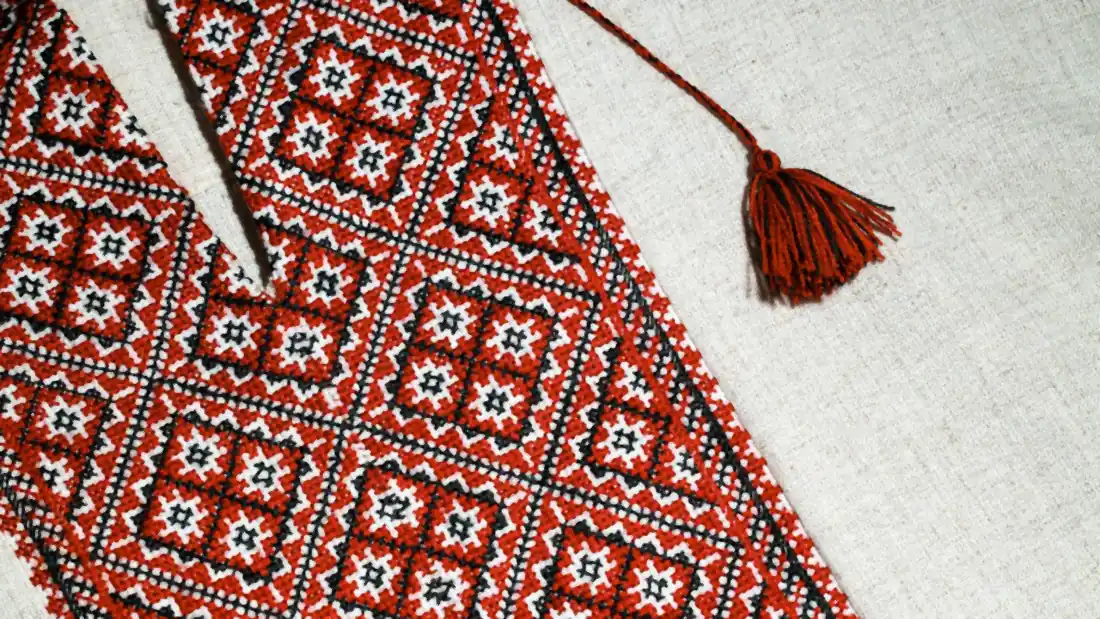
Ukrainian embroidered shirts: 6 cuts, techniques and regions
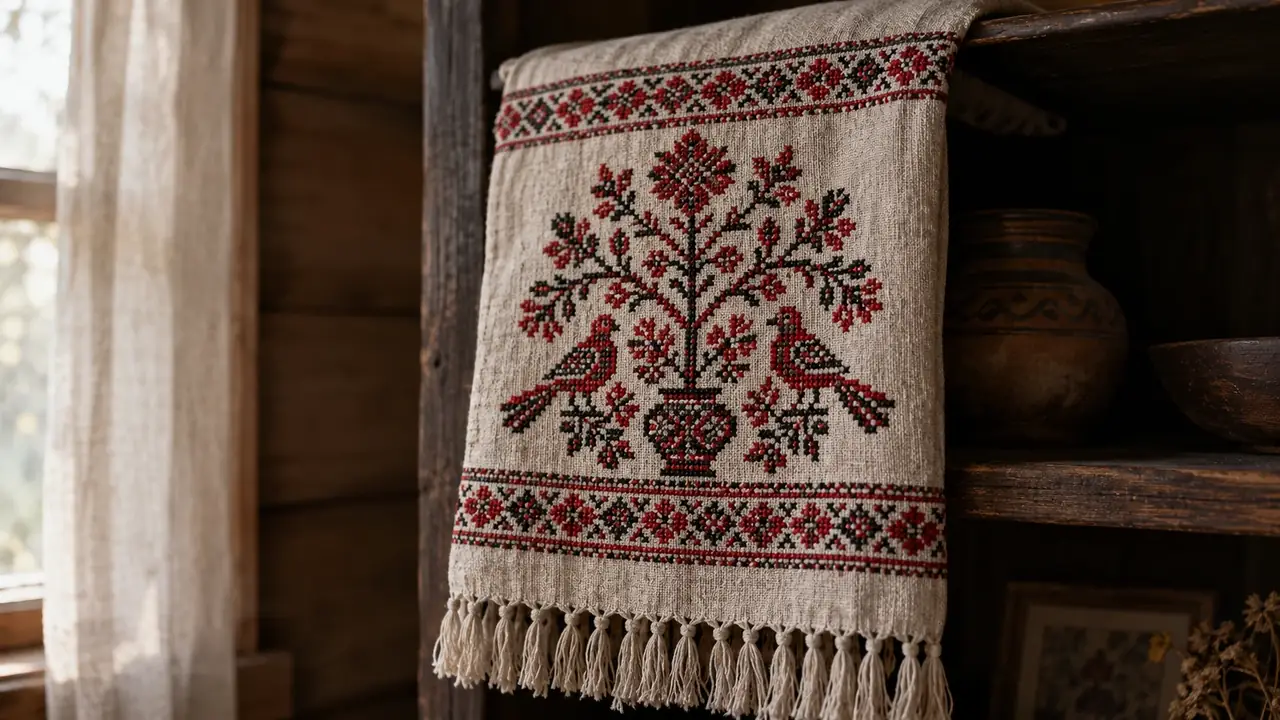
The Ukrainian rushnyk: types, meaning and wedding traditions

How to Style a Vyshyvanka: An Everyday Guide
Embroidery motifs
The generator builds this region's vyshyvanka from these motifs, combining them differently every day. What the symbols mean
Chest and collar
Sleeve
- Broken branch (hilce)
Dominant colors
Also found
The main colors of this region's pattern, not a complete list of every shade found in real embroidery.
Updated:
Sources
-
Полтавська народна вишивка
- Кара-Васильєва Т.В.
(1983)
Київ: Наукова думка, 1983. 136 с. -
Історія української вишивки
- Кара-Васильєва Т.В.
(2008)
К.: Мистецтво, 2008. Національна премія ім. Т.Шевченка, 2012. -
Полтавська традиційна вишивка
- Титаренко В.П.
(2019)
Вісник Національної академії керівних кадрів культури і мистецтв, 2019, № 4, с. 60-65. -
Національний перелік елементів нематеріальної культурної спадщини України
- Міністерство культури та інформаційної політики України
(2023)
Борщівська народна вишивка - наказ від 13.10.2020 № 2182; вишивка «білим по білому» Решетилівки - наказ від 29.06.2017 № 561; вишивка жіночої сорочки на Гадяччині - наказ від 12.07.2023 № 380; клембівська сорочка «з квіткою» - наказ від 13.10.2020 № 2182. Орьнек - кримськотатарський орнамент та знання про нього - наказ від 12.02.2018 № 105.