Ukrainian embroidered shirts: 6 cuts, techniques and regions
· Updated:

Contents
- What types of vyshyvanka are there: the short answer
- 6 types of vyshyvanka by cut
- Types of vyshyvanka by embroidery technique
- Types of vyshyvanka by region
- Women's and men's vyshyvankas: the differences
- Festive, everyday and wedding vyshyvankas
- FAQ about the types of vyshyvanka
- Sources
- Regions in this article
Types of vyshyvanka, the Ukrainian embroidered shirt, are told apart by cut, embroidery technique, region and purpose. By cut, ethnographers and museums describe six main types: tunic-cut, the shirt with shoulder inserts, the yoke shirt, the full-length shirt, the shirt with a separate lower part (pidtychka) and the short kutsyk. The technique and the ornament suggest where a vyshyvanka comes from, while the amount and placement of embroidery show whether it was a festive, everyday or wedding shirt.
What types of vyshyvanka are there: the short answer
There are women's, men's and children's vyshyvankas, and festive, everyday and wedding ones. The most precise way to tell them apart is the cut: how the shoulders and sleeves are joined and how the lower part is made. These two features give six types of Ukrainian embroidered shirt. The second feature is technique: white-on-white, nyz, zanyzuvannia, cross-stitch, satin stitch, cutwork, beadwork. The third is region, because every area had its own set of cuts and stitches.
| Type of shirt | What sets it apart | Where it is described |
|---|---|---|
| Tunic-cut | straight, no separate shoulder piece, often no collar | Chernihiv region (men's everyday shirt), Berezne area |
| With shoulder inserts (ustavka) | a separate shoulder piece: ustavka, polyk, vustavka | Volyn, Hutsul region, Bukovyna, Kyiv region |
| Yoke shirt ("do hestky") | a separate yoke sewn on at the top | Zaporizhzhia, Kherson and Donetsk regions |
| Full-length (dodilna) | one piece, long, down to the hem | Kyiv, Chernihiv and Donetsk regions |
| With a pidtychka | upper part of finer linen, lower part of coarser linen | Chernihiv and Kirovohrad regions |
| Kutsyk | a short shirt to the waist | Chernihiv region, second half of the 20th century |
6 types of vyshyvanka by cut
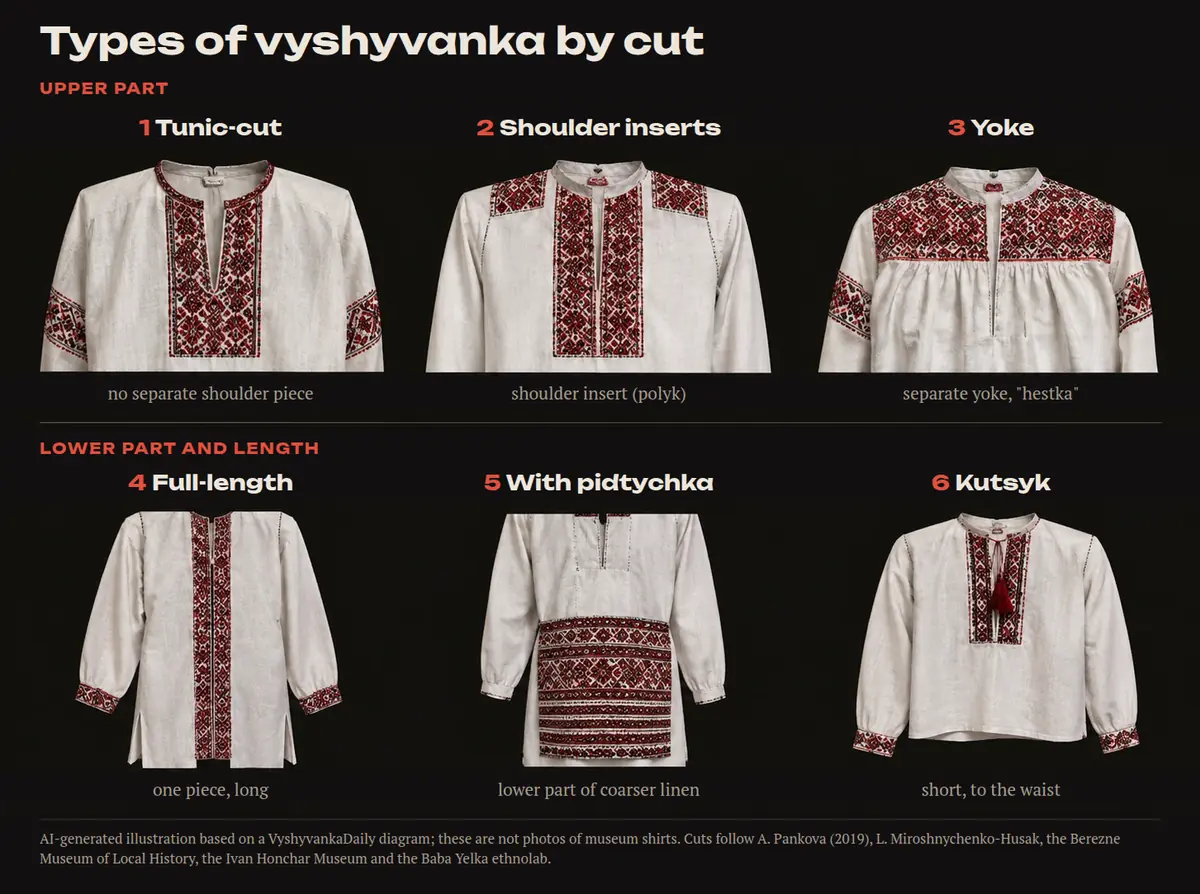
The cut of a vyshyvanka is described by two features. The first is the upper part: tunic-cut, with shoulder inserts or with a yoke. The second is the lower part and length: full-length, with a pidtychka or a short kutsyk. So one shirt can be both a shoulder-insert shirt and a full-length one, like the museum shirt from Kodaky in the Kyiv region.
1. Tunic-cut shirt
The tunic-cut vyshyvanka has the simplest cut: a straight shirt with no separate shoulder piece. In the Chernihiv region the everyday men's shirt was made this way. According to the ethnographic expedition materials described by Anastasiia Pankova in 2019, it was sewn from coarse grey unbleached linen or hemp cloth: straight-cut, collarless, reaching a little below the waist. Men wore it untucked with a belt. The Berezne Museum of Local History in the Rivne region also lists the tunic-cut shirt among the main cuts of Polissia.
2. Shirt with shoulder inserts (ustavka)
The ustavka shirt has a separate shoulder piece, the ustavka, which in Volyn is also called the polyk or vustavka. In her study of Volyn embroidery and dress, Liudmyla Miroshnychenko-Husak, an ethnographer at the Volyn Museum of Local History, gives exactly this cut: long but not very wide sleeves with cuffs, and a shoulder insert. In Bukovyna a rectangular shoulder insert is sewn onto the rectangular front and back panels, explains Liubov Svarnyk of the Museum of Folk Architecture and Rural Life in Lviv. The Hutsul women's shirt always had shoulder inserts: the embroidered band was sewn in at the shoulders as a separate piece rather than stitched onto one length of linen.
This type of Ukrainian embroidered shirt is very old. The 2018 expedition in the Chernihiv region named the shoulder-insert shirt of homespun linen the oldest women's type there. In the Pidhiria villages of the Zhydachiv area the insert was not even embroidered but woven. According to a 2022 study by Olena Nykorak and co-authors, it was a rectangle of about 20 by 20 centimetres with purple-red rhombuses.
One trap in the terms: in Podillia the word "ustavka" meant something else. Researchers at Khmelnytskyi National University, I. Zasornova and O. Selska with A. Mychko (2016), divided the women's shirts in the Khmelnytskyi Regional Museum of Local History into two types, "with ustavkas" and "without ustavkas". There the ustavka is the underarm gusset, rhombic, square or rectangular, not a shoulder piece.
3. Yoke shirt, or "do hestky"
The yoke shirt has a separate yoke at the top, with the body sewn onto it. Such shirts are found all over Ukraine, but there are very many of them in the Zaporizhzhia region, where the "do hestky" shirt gradually pushed out older cuts. In the Donetsk region yoke shirts, called "do hestky" or "do taliiky", spread at the end of the 19th century, mostly in factory-made cloth. Maryna Askurava, a senior researcher at the Kherson Regional Museum of Local History, calls this cut popular in the south, where homespun linen was used less.
4. Full-length shirt (dodilna)
The dodilna vyshyvanka is a one-piece long shirt reaching down to the hem. A good example is the women's shirt from the village of Kodaky in the Kyiv region, now in the Ivan Honchar Museum. It dates from the first half of the 20th century and is full-length, 125 centimetres long, with shoulder inserts and a side opening at the chest. The museum published its embroidery charts and cutting pattern, so the shirt can be reproduced. In the Chernihiv region festive shirts were mostly full-length, and in the Donetsk region the women's shirt was long, down to the hem, with dense embroidery at the top.
5. Shirt with a pidtychka
The shirt with a pidtychka has two parts: the top is made of finer linen and the lower part, the pidtychka, of coarser cloth. In the Chernihiv region, Pankova notes, the choice between a full-length shirt and a shirt with a pidtychka depended on a family's means. In the Kirovohrad region the pidtychka was removable: the lower part, which was not visible, was made of homespun linen, so it could be unpicked and sewn onto a new top. A shirt from the village of Tsvitne is built this way: a cotton top embroidered with berries and an old pidtychka decorated with cutwork.
6. Kutsyk
The kutsyk is a short shirt reaching to the waist, the youngest type in this list. In the Chernihiv region it spread from the second half of the 20th century and was worn under a skirt with a bib. There, too, a simple shirt was sewn from three panels and a festive one from factory-made calico from two, so Chernihiv embroidery gradually moved from homespun linen to bought cloth.
The Berezne museum also lists a shirt with a one-piece sleeve among its cuts, and in Zakarpattia, in the Tiachiv and Vynohradiv areas, people wore Wallachian shirts with a wide rectangular insert called puslyky. So the six types are the basis, not a complete list: every area had its own variants.
Types of vyshyvanka by embroidery technique
The embroidery technique often reveals the region faster than the cut. White satin stitch on white linen, nyz worked from the reverse, zanyzuvannia that looks woven, cross-stitch, satin stitch, cutwork and beads each have their centres. These are the main techniques that define types of Ukrainian embroidery.
| Technique | What it looks like | Where it is best known |
|---|---|---|
| White-on-white (lyshtva, cutwork, "nightingale eyes") | white thread on white linen, the pattern shows through relief | Poltava region, Reshetylivka; also Sloboda Ukraine, Chernihiv region |
| Nyz, or nyzynka | worked from the reverse, the front looks raised, almost woven | Eastern Podillia, Vinnytsia region; Hutsul region |
| Zanyzuvannia | the thread passes under the threads of the linen, so the pattern looks woven | Polissia: Zhytomyr and Volyn regions, north of the Kyiv region |
| Cross-stitch (Brocard embroidery) | red and black floral motifs: roses, grapes, guelder rose | almost everywhere from the late 19th century, most of all the Kyiv and Kirovohrad regions and the south |
| Hapt (double-sided satin stitch) | dense, raised coloured satin stitch | Yavoriv area, Lviv region |
| Cutwork (vyrizuvannia) | some threads of the linen are removed and the gaps are finished | Khmelnytskyi, Kharkiv and Dnipropetrovsk regions |
| Beads, sequins, metal thread | the shine of metal thread and beads | Bukovyna (Chernivtsi region) |
| Wool embroidery | the sleeve almost entirely covered in black wool | Borshchiv area, Ternopil region |
Two of these traditions have official status. The white-on-white embroidery technology of Reshetylivka is on the National List of Elements of the Intangible Cultural Heritage of Ukraine. In 2023 the tradition and technology of embroidering the women's shirt in the Hadiach area was added. Both come from the Poltava region, and Poltava embroidery is best known for white work, where the pattern shows not through colour but through relief.
Techniques rarely live alone. Volodymyr Shukhevych described twelve techniques of Hutsul embroidery in his work "Hutsulshchyna", and Oleksandra Holosna counted more than 70 techniques in the folk embroidery of the Sumy region. On the single Kodaky shirt the embroiderer combined satin stitch, slanted satin stitch, cross-stitch, shtapivka, vystih and vystrochky. Cross-stitch came late: in the Zhytomyr region zanyzuvannia is considered the oldest, then satin stitch, and cross-stitch only from the mid-19th century.
Types of vyshyvanka by region
Regional types of vyshyvanka do not follow oblast borders. Four traditions live side by side in the Kyiv region. They are Polissia geometry in zanyzuvannia in the north, Brocard cross-stitch on the Right Bank, satin stitch and cutwork on the left bank, and white-on-white closer to the Poltava region. In the Lviv region the Sokal shirt, with black cross-stitch and large areas of bare linen, stands next to the dense coloured satin stitch of Yavoriv.
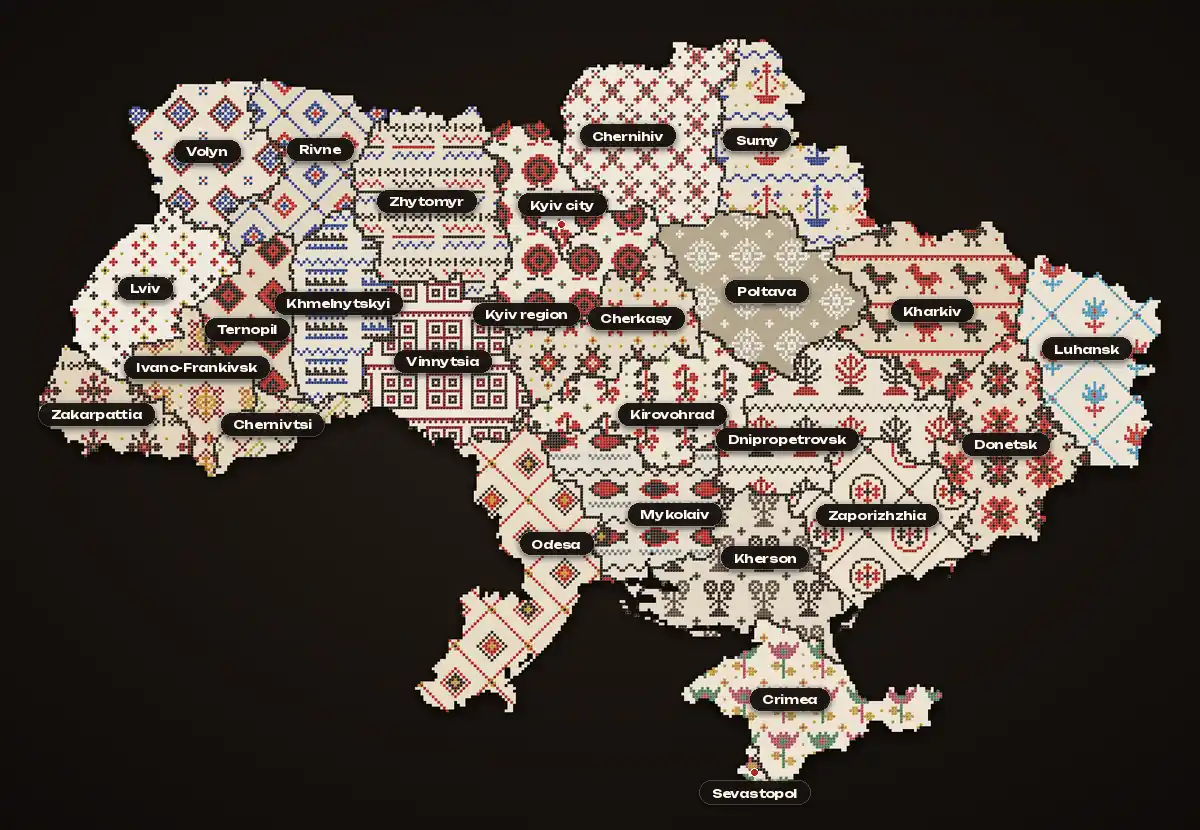
Simplified to the main parts of Ukraine, the regional types of vyshyvanka look like this.
- Polissia - zanyzuvannia, geometric patterns, mostly red; in the Zhytomyr region the sleeve was covered completely.
- Podillia - nyz, cutwork, single-colour shirts; in the Khmelnytskyi region strict geometry with no plant motifs.
- Carpathians and Bukovyna - shirts with shoulder inserts, complex geometry, beads, sequins and metal thread.
- Galicia and Western Podillia - black Sokal shirts, Yavoriv hapt, Borshchiv wool.
- Centre and Left Bank - white-on-white, tiny Chernihiv stitches that look like beads, Brocard cross-stitch.
- South and East - "do hestky" yoke shirts, the Zaporizhzhia chumak shirt with embroidery only on the collar, the braided merezhka along the hem in the Luhansk region.
How embroidery differs from region to region, which motifs and colours were used and which sources tell us so, is shown on the vyshyvanka map of Ukraine with all 27 regions.
Women's and men's vyshyvankas: the differences
In many regions the women's vyshyvanka was longer and more heavily decorated, while the men's was plainer, with embroidery in a few places. In the Donetsk region the women's shirt reached the hem, with dense embroidery at the top. The men's shirt was embroidered on the chest, cuffs and collar and worn untucked with a red or blue belt. In the Chernihiv region the festive men's shirt was decorated on the chest opening, the small stand-up collar and the cuffs. The plainest is the chumak shirt of the Zaporizhzhia region: embroidery only as a narrow band on the collar, because it was a shirt for the road and hard work.
The difference is not always in technique. In the Poltava region white embroidery was festive for both women and men, and there is no separate men's technique; the cut and the placement of the decoration differed. In the Kirovohrad region men's shirts typically carry oak-leaf motifs or geometry, while women's shirts show the full range of herbs and flowers. In Volyn the bride had to embroider the groom's shirt, so the men's vyshyvanka was also women's work. There are children's shirts too: the Volyn Museum of Local History received a pre-war child's shirt of homespun linen, with geometry around the neck and flowers on the sleeves.
Festive, everyday and wedding vyshyvankas
A festive vyshyvanka differed from an everyday one in linen, colour and the amount of embroidery. Iryna Diachuk, director of the Luhansk Regional Museum of Local History, says festive shirts there were embroidered in red, grey and light blue with roses and lilies. Everyday ones were done in pale green and pale yellow with small wildflowers. In Bukovyna the sleeves of a festive shirt were fully covered in multicoloured patterns, while an everyday shirt was made of coarser linen and embroidered only at the neck and on the sleeves.
The wedding shirt is a type of its own. In Volyn Polissia horizontal bands covered the whole sleeve of a wedding shirt, while an everyday one might have only a narrow strip by the cuff. Women made a lot of shirts. Maryna Askurava of the Kherson museum says that even a poor village woman had at least thirty festive shirts, not counting everyday ones, and wealthier women up to a hundred. Most of them were made before marriage.
It was not only shirts that were divided by purpose. The same goes for the types of rushnyk, the embroidered ritual towel: in the Chernihiv region the expedition recorded local names such as utyrach, nabozhnyk, krasnyi, orlystyi and krolevetskyi.
FAQ about the types of vyshyvanka
How many types of vyshyvanka are there?
There is no single list, because vyshyvankas are classified by different features. By cut, researchers describe six main types: tunic-cut, with shoulder inserts, with a yoke, full-length, with a pidtychka and the kutsyk. There are far more techniques: Oleksandra Holosna counted over 70 in the Sumy region alone. Add region, purpose and who the shirt was made for, and the types run into dozens.
What is the oldest type of vyshyvanka?
By cut, the 2018 expedition considers the shoulder-insert shirt of homespun linen the oldest women's type in the Chernihiv region. Among techniques, zanyzuvannia in Polissia and white-on-white embroidery are among the oldest. Brocard cross-stitch is the youngest layer: it spread at the end of the 19th century with patterns that came packed with soap.
What is an ustavka on a vyshyvanka?
Usually the ustavka is a separate shoulder piece of the shirt, also called the polyk or vustavka in Volyn. It is embroidered separately and sewn in between the front and back panels. In Podillia, however, the underarm gusset, rhombic, square or rectangular, was called the ustavka, so a "shirt with ustavkas" there means a different cut.
How can you tell the region from the type of vyshyvanka?
The most reliable way is the combination of cut and technique. White satin stitch and cutwork point to the Poltava region or Sloboda Ukraine, black nyz on white to Podillia, a sleeve densely covered in wool to Borshchiv, beads and metal thread to Bukovyna. A simple test in Western Ukraine: if a lot of linen is left bare, it is most likely Sokal; if almost none, Borshchiv.
How does a men's vyshyvanka differ from a women's?
A men's vyshyvanka is usually plainer: embroidery went on the collar, chest, chest opening and cuffs, while women's shirts were embroidered more heavily, especially on the sleeves. The technique could be the same, as in the Poltava region, with the cut and placement of embroidery making the difference. Men's motifs could differ too: in the Kirovohrad region they were oak leaves or geometry.
Sources
- Народна культура Чернігівського району (традиція та сучасний стан побутування). Збірник за матеріалами етнографічної експедиції 2018 року, 2019 (розділ А. Панкової про сорочки).
- Мірошниченко-Гусак Л. (упор.). Традиційні жіночі сорочки Волині та Західного Полісся кінця XIX-XX століть. Волинський краєзнавчий музей.
- Засорнова І. О., Сельська О. О., Мичко А. А. Класифікація конструктивних елементів українських національних сорочок Поділля, 2016.
- Березнівський краєзнавчий музей. Оцифрована колекція сорочок Волинського Полісся.
- Музей Івана Гончара. Жіноча сорочка з с. Кодаки, перша половина XX століття, КН-22006: опис, схеми вишивки та крою.
- Никорак О., Куцир Т., Юсипчук Ю., Білий В. Підгірські жіночі взористі сорочки, 2022.
- Лозинський Т. Буковинські жіночі сорочки. Каталог приватних та музейних творів; пояснення Л. Сварник (Музей народної архітектури та побуту у Львові).
- Херсонський обласний краєзнавчий музей, пояснення М. Аскурави.
- Луганський обласний краєзнавчий музей, пояснення І. Дьячук.
- Голосна О. С. Історія української вишиванки на Сумщині, 2017.
- Шухевич В. Гуцульщина.
- Міністерство культури та інформаційної політики України. Національний перелік елементів нематеріальної культурної спадщини України.
- Етнолабораторія «Баба Єлька» (Кропивницький), матеріали експедицій.
If you notice a mistake, please let us know.