Volyn Oblast
◇ DocumentedContents
- A wedding shirt from Polissia
- Volyn embroidery ornament: stars, rhombuses and a band at the fold
- Colours in Volyn vyshyvankas
- Where Volyn samples are kept
- Volyn and the Rivne region: a shared palette, different patterns
- The inset-sleeve shirt
- From woven shirts to cross-stitch
- 378 shirts in one catalogue
- Wedding dress from the museum collection
- Olena Pchilka's album and a shirt from Kolodiazhne
- Frequently asked questions
- Articles about this region
- Embroidery motifs
- Dominant colors
- Sources
Volyn embroidery is built on geometry: stars, rhombuses and zigzags set one inside another, in red on linen with touches of blue and black. In the Polissian north the sleeves of a festive shirt were covered entirely in horizontal bands, while in western Volyn a narrow strip of embroidery ran along the fold of the sleeve near the cuff.
The collection of one of the Volyn museums holds a shirt from the village of Vyshniv in the Kovel area. It was embroidered for a particular bride for a particular wedding, and it shows what a festive Volyn vyshyvanka was meant to be.
A wedding shirt from Polissia
According to a researcher's description, the sleeves of such a shirt had to be completely covered in horizontal bands - bright, richly ornamented, voluminous, with a shape of their own. This is not a small detail on the cuff but a solid filling of the whole sleeve.
This is how people embroidered in the Polissian part of the region, particularly around Kamin-Kashyrskyi and Ratne. The collar could be a turn-down or a stand-up one - the choice depended on the fashion of a particular time and village.
A skirt worn with such a shirt was often trimmed with a strip of factory fabric printed with roses - a detail that came from urban fashion but took root in the village. This is how the Volyn vyshyvanka appears in wedding photographs from the early 20th century.
Volyn embroidery ornament: stars, rhombuses and a band at the fold
Outside the wedding context, the basis of the pattern is a rhythmic repetition of geometric figures: stars, rhombuses and broken lines set one inside another. A smaller rhombus inside a larger one creates a sense of depth in completely flat embroidery.
A purely western Volyn technique is a narrow band of embroidery right at the fold of the sleeve near the cuff. This thin line went where the sleeve wore out most and was most often on view.
Different researchers interpret the meaning of these forms differently, so we do not present any version as the only correct one.
Colours in Volyn vyshyvankas
Red on linen prevails. Blue and black work as additions, not as equal colours. This is true above all of Volhynian Polissia in the north of the region, while in western Volyn, according to the ethnographer Liudmyla Miroshnychenko-Husak, the palette is polychrome.
The cloth matters here. It was woven from flax and hemp that people grew themselves, and special attention was paid to its colour: the whiter and finer the cloth, the better the embroiderer was considered.
Where Volyn samples are kept
The Volyn Regional Museum of Local History in Lutsk maintains a permanent collection of folk dress and embroidery, and the story of the wedding shirt from Vyshniv comes from there.
The Kamin-Kashyrskyi Folk Museum of Local History, founded in 1980 by the teacher and local historian Vasyl Kmetsynskyi, focuses on the Polissian part of the region - the part where sleeves were covered with solid bands. Here the vyshyvankas of Volyn Oblast are shown in the context of everyday life rather than as separate exhibits.
Volyn and the Rivne region: a shared palette, different patterns
Both regions have an almost identical palette - red with touches of blue and black, and the same linen. But the patterns differ: Volyn figures nest inside each other, while Rivne ones keep to a simpler repeat.
In this sense the Rivne region is more archaic. Volyn embroidery took a more complex path with the same restraint in colour.
The inset-sleeve shirt
Liudmyla Miroshnychenko-Husak, ethnographer and deputy director for research at the Volyn Regional Museum of Local History, explains that the Volyn vyshyvanka has long but not very wide sleeves with cuffs and a shoulder insert called a polyk or vustavka. It is neatly separated from the sleeve by decorative openwork seaming.
The oldest items in the museum collection date from the end of the 19th century, and most from the first half of the 20th. The holdings include more than 400 women's and just over 100 men's shirts, both embroidered and woven.
A shirt from the former Stara Vyzhivka district shows the Polissian variant: the insert and the top of the sleeve are embroidered in zanyzuvannia, an old technique that imitates weaving, while the cuffs and the standing collar are in cross-stitch. Here the pattern covers only the upper part of the sleeve, not its whole length.
From woven shirts to cross-stitch
The oldest shirts in the museum collection are woven: older women still wore them at the beginning of the 20th century. Cross-stitch became very popular closer to the middle of the century, and decorative satin stitch, not previously typical of Volyn, arrived with fashion from the neighbours - first on headscarves and aprons, sometimes on shirts.
The museum also shows two outfits from different times. A woman's outfit from the village of Zghoriv in the former Lokachi district belonged to a fairly well-off woman who could buy coloured threads and velvet. A girl's outfit from the village of Svichiv in Volodymyr district dates from the early 1940s, and its skirt is embroidered with beads along the hem - a rarity in Volyn embroidery.
378 shirts in one catalogue
In 2013 the catalogue "Traditional Women's Shirts of Volyn and Western Polissia, Late 19th-20th Centuries", compiled by Liudmyla Miroshnychenko-Husak and Tetiana Khomova, was published in Lutsk. It covers 378 shirts from every district of the region, with an analysis of cut, decoration and ornament. For the Volyn vyshyvanka it is the fullest description of a single museum collection.
According to the catalogue, Polissian shirts were sewn from raw or half-bleached linen. They were decorated with weaving or with the "zatiahuvanka" stitch, which repeated the woven ornament; the cut is the ustavka type, the collar turned down, and the main colour red, sometimes with a touch of blue.
Wedding dress from the museum collection
From items in the Volyn Regional Museum of Local History collection, Miroshnychenko-Husak also assembled a wedding outfit. The bride stood out thanks to colourful necklaces, corals or "patsiorky" beads and a wreath; a sleeveless vest was obligatory, and the crowns varied: tall wreaths or small cap-like ones. The bride was supposed to embroider the groom's shirt, so the men's Volyn vyshyvanka was a woman's work too. Festive dress was always belted: men's belts were wider, women's narrower.
Olena Pchilka's album and a shirt from Kolodiazhne
Volyn also has its own page in the history of ornament research. Olena Pchilka (Olha Kosach) collected patterns in Volyn and in 1876 published in Kyiv the album "Ukrainian Folk Ornament", with patterns of embroidery, weaving and pysanky. The eighth edition, with a reprint of the album, was produced by the Volyn Regional Museum of Local History and the Lesia Ukrainka Literary and Memorial Museum in Kolodiazhne.
And the Volyn museum received a pre-war child's embroidered shirt from a farmstead between Kolodiazhne and Voloshky: homespun linen, polychrome embroidery with openwork cutwork, geometry around the neck and flowers on the sleeves. Volyn vyshyvankas, it seems, were not made only for grown-up festivities.
Frequently asked questions
How did a festive shirt differ from an everyday one?
In how densely the sleeve was decorated. On a wedding shirt the crosswise bands covered the whole sleeve, while an everyday shirt might have only a narrow strip of embroidery near the cuff.
What is the strip at the bend of the sleeve?
A purely western Volhynian technique: a thin line of embroidery right at the bend of the sleeve near the cuff, rather than a wide band along its full length. This was the spot that wore out most and was most often in view.
What kind of cloth was valued in Volyn?
Bleached and fine, of linen or hemp. The whiter and finer the cloth, the better the embroiderer was considered, and the cloth itself gave a Volyn vyshyvanka its festive look.
What is an inset-sleeve shirt?
A shirt with a separate shoulder piece - an insert, which in Volyn is also called a polyk or vustavka. It is separated from the sleeve by decorative openwork seaming.
Who embroidered the groom's shirt?
The bride. According to Liudmyla Miroshnychenko-Husak, an ethnographer at the Volyn Regional Museum of Local History, the groom's shirt was supposed to be embroidered by her.
If you notice a mistake, please let us know.

Gallery
Articles about this region
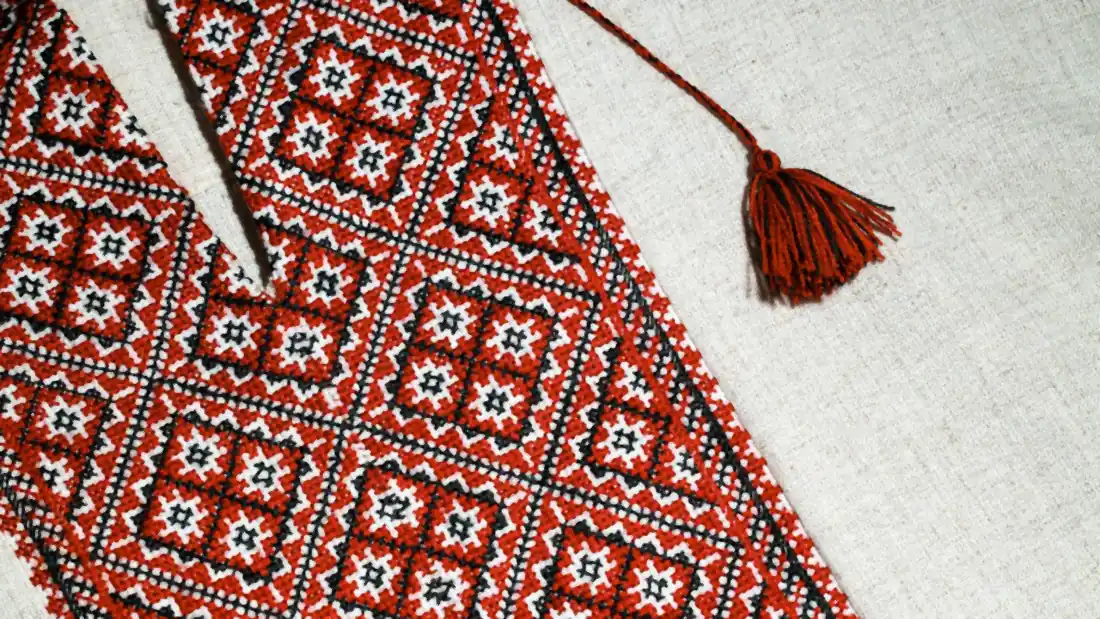
Embroidery motifs
The generator builds this region's vyshyvanka from these motifs, combining them differently every day. What the symbols mean
Chest and collar
Borders
- Chain of rhombuses
- Teeth
Dominant colors
The main colors of this region's pattern, not a complete list of every shade found in real embroidery.
Updated:
Sources
-
Українська народна вишивка. Західні області УРСР
- Захарчук-Чугай Р.В.
(1988)
К.: Наукова думка, 1988. -
Традиційні жіночі сорочки Волині та Західного Полісся кінця XIX-XX століть
- Волинський краєзнавчий музей; упор. Л. Мірошниченко-Гусак, Т. Хомова
(2013)
Каталог збірки. Луцьк: Волинські старожитності, 2013.