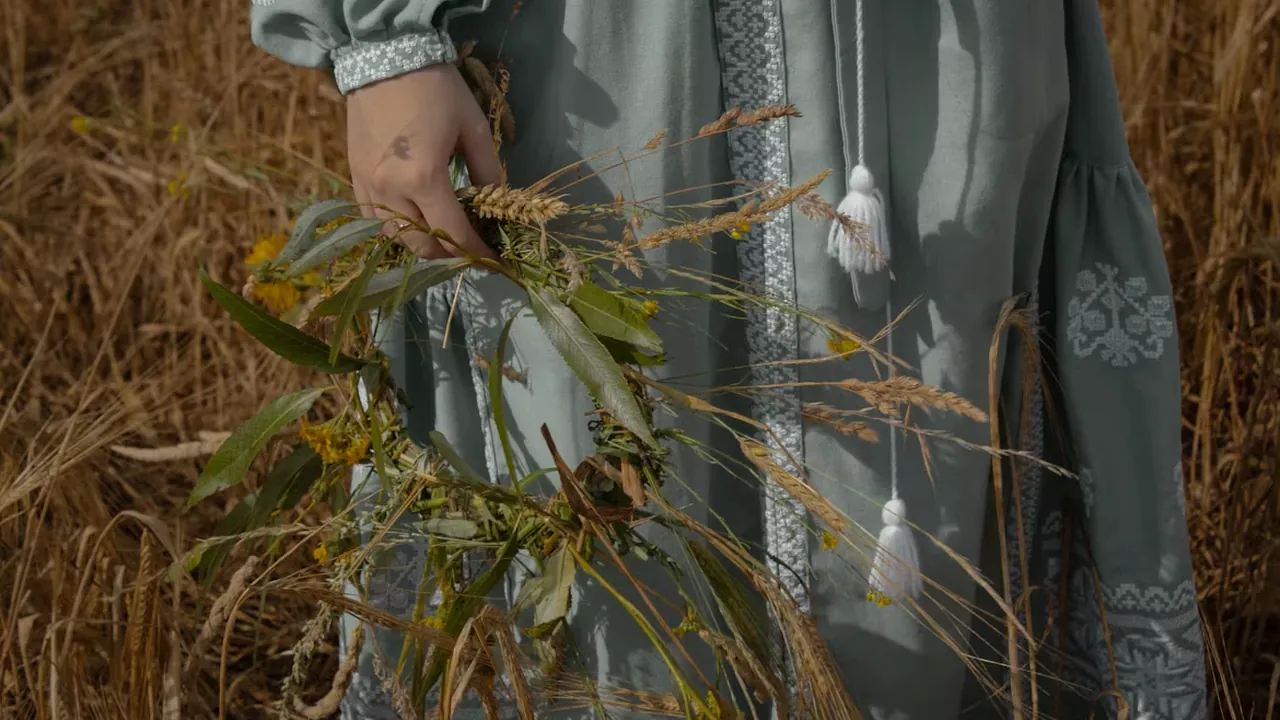
20 interesting facts about the Ukrainian vyshyvanka, plus 4 myths
· Updated:

Contents
- The vyshyvanka: history and interesting facts
- Interesting facts about the Ukrainian vyshyvanka: how it was made
- Facts about the Ukrainian vyshyvanka: what the pattern told people
- Interesting facts about Vyshyvanka Day and heritage
- Myths and facts about the vyshyvanka
- Frequently asked questions about the vyshyvanka
- Sources
- Regions in this article
The most interesting facts about the vyshyvanka, the Ukrainian embroidered shirt, are rarely legends. They are concrete things: who invented Vyshyvanka Day, where cross-stitch came from, how many festive shirts a village woman owned and why a pattern could tell you which village someone came from. We collected 20 facts confirmed by museums, academic papers and interviews with specialists, and separately looked at popular myths that the sources do not support.
Every fact here has a source listed at the end. Where we mention what a symbol means, we say whose interpretation it is.
The vyshyvanka: history and interesting facts
The history of the vyshyvanka as we know it is shorter and more surprising than the "thousands of years" myths. Cross-stitch arrived in the late 19th century, the fashion for wearing a vyshyvanka with a jacket came with Ivan Franko, and the holiday dates from 2006.
| Year | Event |
|---|---|
| 1876 | Olena Pchilka publishes the album "Ukrainian Folk Ornament" in Kyiv, with patterns collected in Volyn |
| late 19th - early 20th c. | Cross-stitch spreads: patterns are printed on cards that Brocard and Co. gave away with soap and perfume |
| 1960s-1980s | The Shevchenko embroidery association works in Kyiv: about 2,000 workers, exports to the US, Canada and Japan |
| 2006 | Student Lesia Voroniuk in Chernivtsi starts Vyshyvanka Day |
| 2017 | Reshetylivka embroidery is added to Ukraine's National Intangible Heritage List |
| 2021 | Ornek, the Crimean Tatar ornament, joins the UNESCO Representative List |
| 2023 | The women's shirt embroidery of the Hadiach area is added to the National List |
1. Lesia Ukrainka's mother collected embroidery ornaments
Olena Pchilka (Olha Kosach), a writer and the mother of the poet Lesia Ukrainka, collected embroidery, weaving and pysanka (Easter egg) ornaments in Volyn. In 1876 she published the album "Ukrainian Folk Ornament" in Kyiv. It has been reissued several times: the eighth edition, with a facsimile, was prepared by the Volyn Regional Museum and the Lesia Ukrainka Museum in Kolodiazhne.
2. Ivan Franko made the vyshyvanka with a jacket fashionable
Ivan Franko wore an embroidered shirt under his jacket on weekdays and holidays alike, and started that fashion among Galicians. Bohdan Tykholoz, director of the Franko House in Lviv, told Radio Liberty that at the time this was a deliberate choice. The vyshyvanka was becoming a sign of national identity rather than just part of peasant dress. People from different regions gave the writer embroidered shirts as gifts.
3. Cross-stitch arrived with soap
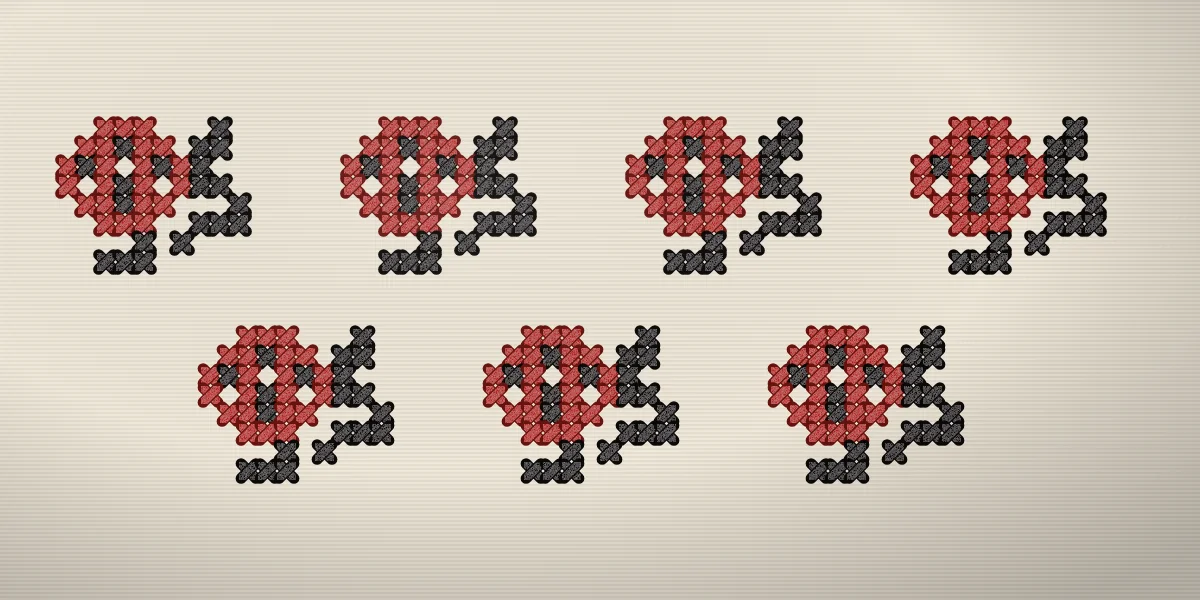
Cross-stitch, which now looks like the most typical vyshyvanka technique, only spread in the late 19th and early 20th centuries. The folklorist Volodymyr Shchybria (Centre of Folklore and Ethnography, Kyiv University) explains that the perfume company Brocard and Co. gave away printed cards with floral cross-stitch patterns together with perfume and soap. This is how "Brocard" embroidery appeared: roses, carnations and violets in red and black thread. According to the folklorist Viacheslav Vinchura, in the south it pushed out older techniques almost entirely.
4. New patterns came in European fashion magazines
In Zakarpattia, floral ornament spread widely on shirts in the 1920s. The ethnologist Vasyl Kotsan, director of the Transcarpathian Museum of Folk Architecture and Life, writes that it came with fashion magazines carrying patterns from Czechoslovakia, Italy and France.
5. Embroidery from Kyiv went to Japan
In the 1960s-1980s the Shevchenko production and art association worked in Kyiv with about two thousand employees. As the researcher A. Varyvonchyk (Kyiv National University of Culture and Arts) writes, its embroidery was exported to the United States, Canada and Japan. For more than 30 years its chief artist was Nina Hrechanovska. The association closed in 2004.
6. Men used to embroider too
Not all embroidery was women's work. According to the Encyclopedia of Modern Ukraine, in the Crimean Khanate gold embroidery on saddle cloths, tents and the clothes of the khan and nobility was done by male embroiderers organised in guilds. Only after the khanate fell did gold embroidery pass to women and into the home.
Interesting facts about the Ukrainian vyshyvanka: how it was made
Ukrainian embroidery means hundreds of techniques, thread dyed with bark and berries, and work that took months and sometimes years.
7. There are hundreds of techniques
The embroiderer and researcher Vira Roik described 300 embroidery techniques, writes Valentyna Tytarenko in her paper on Poltava embroidery. The researcher Olena Holosna counts more than 70 techniques in the Sumy region alone. In Borshchiv, according to Viktoriia Kryvonis, head of the School of the Borshchiv Folk Shirt, of roughly 250 embroidery techniques documented in Ukraine, more than 60 appear in the Borshchiv shirt. One Borshchiv shirt was studied for about 15 years. How these techniques combine with different cuts is covered in our guide to the types of vyshyvanka.
8. One shirt took from two weeks to three years
According to the Cherkasy Regional Art Museum, embroidering one shirt took anywhere from two weeks to three years. The Sumy embroiderer Nataliia Babenko puts a shirt of medium difficulty at a month of work and a rushnyk, a ritual embroidered towel, at six months to two years. The Cherkasy artist Nataliia Kramna-Taran spends 2-3 months on a shirt, working eight hours a day.
9. Colours came from bark, berries and the bread oven
Thread was dyed at home with whatever was at hand. In the Poltava region, according to Valentyna Tytarenko, dyes were made from oak and alder bark, elderberry and mulberry. In the Kirovohrad region, the researcher Inna Tilnova suggests that the thread of one old shirt was baked in a loaf of bread, and the linseed oil turned it yellow. Home dyes were not always fast: on shirts from Zaporizhzhia, black thread faded over a century to a greyish red.
10. Whole regions embroidered white on white
White embroidery on white linen is not a fashion whim but an old tradition of several regions. White-on-white work was done across the Chernihiv region, in the Poltava region and in the northern districts of the Luhansk region. The best-known school is Reshetylivka, and the Poltava vyshyvanka long kept to white and grey.
11. The bride embroidered the groom's shirt
In Volyn the bride had to embroider the groom's shirt herself, says Liudmyla Miroshnychenko-Husak, deputy director of the Volyn Regional Museum, who assembled the wedding clothes from the museum's collection. The bride stood out by her necklaces, corals or glass beads and her wreath.
Facts about the Ukrainian vyshyvanka: what the pattern told people
The embroidery on a shirt worked like a document: it showed where a person came from and sometimes whether a woman was married.
12. Embroidery identified the village
Vasyl Kotsan writes that in Zakarpattia the ornament of a shirt identified the district, the village and even a particular part of the village. In Zinkiv in the Khmelnytskyi region, according to the local historian Valentyna Kohut, people embroidered in blue or blue and green thread, a combination not found anywhere nearby. The Chernivtsi Regional Museum of Folk Architecture and Life holds 800 embroidered shirts, each at least a hundred years old, and no pattern is repeated.
13. An eight-pointed star meant a married woman
In the Khust area an eight-pointed star rosette decorated the shirts of married women, the Transcarpathian Museum of Folk Architecture and Life explains. The same area made "zaspulnytsi", shirts with rectangular embroidery that were in one or two colours in the late 19th century and later became multicoloured.
14. A village woman could own 30 festive shirts
Women owned far more shirts than you might think. Maryna Askurava, a senior researcher at the Kherson Regional Museum of Local History, says that even a poor village woman had at least 30 festive shirts. Wealthier women had up to a hundred, counting everyday ones. Most shirts were embroidered before marriage. The researcher Viktor Skliar gives 30-50 shirts per woman for the Luhansk region.
15. Shirts were embroidered with cats and dogs
Animal motifs on vyshyvankas are not only roosters. Maryna Askurava says the Kherson museum's collection also has cats and dogs. Shirts from Slobozhanshchyna, according to the Kharkiv Historical Museum, show many birds, animals and human figures.
16. In the Kherson region shirts were often plain
The south was settled late, in the late 18th and early 19th centuries, and the settlers from different regions, in Maryna Askurava's words, "were all strangers to one another". That is why people in the Kherson region often wore shirts with no embroidery at all. For the same reason, Svitlana Romanenko of the Mykolaiv Regional Museum says there is no distinct "Mykolaiv" embroidered shirt.
Interesting facts about Vyshyvanka Day and heritage
A holiday only twenty years old and official heritage status have made the vyshyvanka known far beyond Ukraine.
17. A student invented Vyshyvanka Day
Vyshyvanka Day was started in 2006 by Lesia Voroniuk, then a student at Chernivtsi National University. As she recalls, the idea was simple: pick one day when students and lecturers would all come to class in embroidered shirts. Today the day is marked every year on the third Thursday of May. It is not a public holiday. You can read more in the Wikipedia article on the vyshyvanka.
18. It is marked in more than 100 countries, even in Antarctica
According to Lesia Voroniuk in an interview with Ukrinform, Vyshyvanka Day is marked in more than 100 countries. In 2017 she spoke of at least 60, so the holiday is spreading fast. Ukrainian polar researchers even take vyshyvankas to the Akademik Vernadsky station in Antarctica.
19. Embroidery is on the National List and the UNESCO list
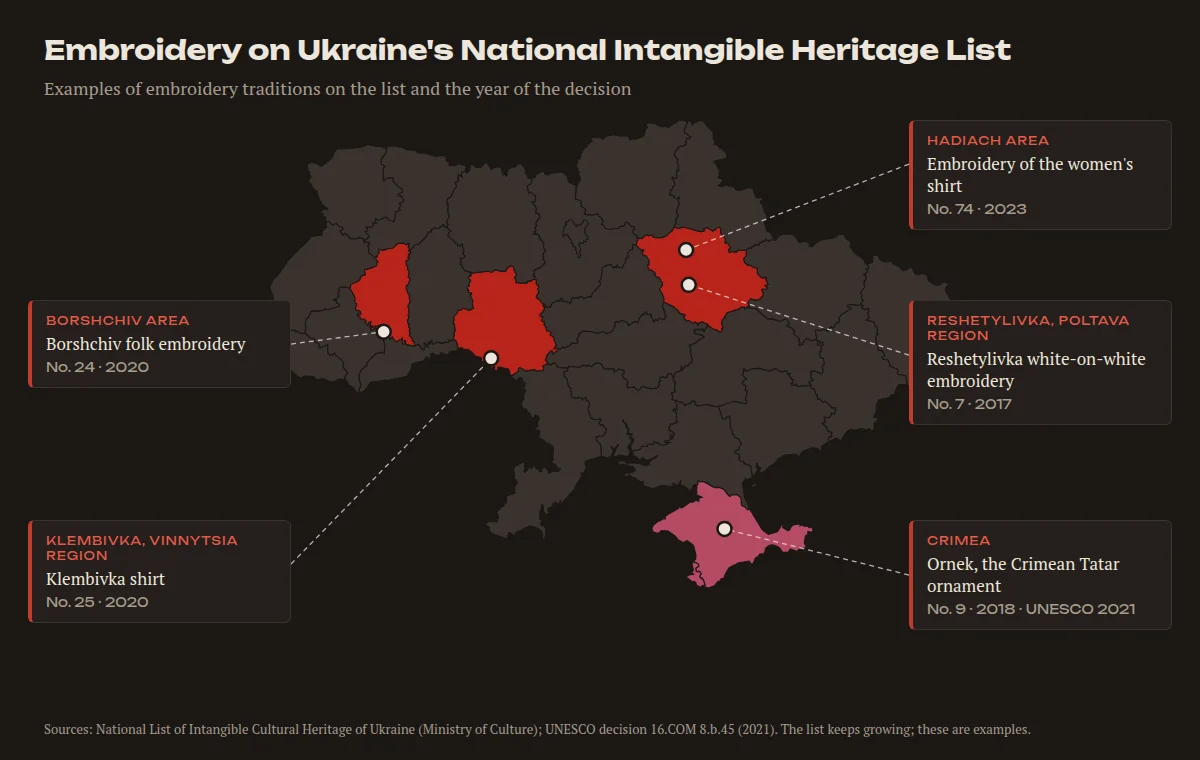
Ukraine's National List of Intangible Cultural Heritage includes Reshetylivka embroidery (No. 7, 2017), plus Borshchiv folk embroidery (No. 24) and the Klembivka shirt from the Vinnytsia region (No. 25, both 2020). In 2023 it added the tradition of embroidering the women's shirt in the Hadiach area (No. 74). The Borshchiv entry names Borshchiv and nearby villages as well as communities in Lviv, Rivne, Zaporizhzhia, Kyiv and the United States. The dark Borshchiv shirts and other Ternopil vyshyvankas have their own page on our site.
The Crimean Tatar ornament ornek, on the National List since 2018 (No. 9), was inscribed on the UNESCO Representative List in 2021. It has about 35 symbols, each with a meaning. According to UNESCO, the rose stands for a married woman, the poplar or cypress for an adult man and the tulip for a young man. The almond means a girl, and the carnation an elderly person. A tulip inside a rose means love or the union of a man and a woman. Ornek is embroidered on clothing and towels, so Crimean embroidery often "speaks" in exactly these signs.
20. Vyshyvankas are still being rescued
After the liberation of the Kharkiv region, Ukrinform reported, a soldier evacuated embroidered shirts, rushnyky and tablecloths from a ruined school ethnographic museum under shelling in late autumn. The roof was damaged, the items were soaking in rain and snow, and some are over a hundred years old. On 18 May 2023 they were shown at a separate exhibition in Chernivtsi. In the project "Occupied Heritage", more than 20 craftspeople and researchers recreated 12 traditional outfits from the Donetsk, Luhansk and other occupied regions, shown at the Ivan Honchar Museum. The project concept was created by Volodymyr Shchybria and Lesia Voroniuk, the founder of Vyshyvanka Day.
Myths and facts about the vyshyvanka
Some of the facts about the vyshyvanka that circulate online have no support in the sources. Here are the four most common.
- "Cross-stitch is the oldest Ukrainian technique." No: cross-stitch spread in the late 19th and early 20th centuries. Older shirts were embroidered with satin stitch, nyz (stitching worked from the back), cutwork and darning stitches.
- "Red means blood and black means grief." These are late interpretations. Volodymyr Shchybria stresses that in the south red and black "carried no separate symbolic meaning".
- "Borshchiv shirts are black in mourning after a Tatar raid." This is a legend; no documents confirm it. What is actually known about the black Borshchiv vyshyvanka is covered separately.
- "Museum vyshyvankas are thousands of years old." Embroidery is indeed ancient, but the oldest shirts in regional museums, according to their staff, mostly date from the late 19th century. A shirt about 200 years old, like the one in the Zinkiv school museum, is a rare find.
Frequently asked questions about the vyshyvanka
When did the vyshyvanka appear?
There is no exact date: embroidery on clothing is old, but the oldest shirts in Ukraine's regional museums mostly date from the late 19th century. A shirt about 200 years old is already a rarity. The familiar cross-stitched vyshyvanka took shape in the late 19th and 20th centuries, and Ivan Franko made it everyday wear rather than only folk dress.
Which Ukrainian artist made the vyshyvanka fashionable?
Ivan Franko started the fashion for the vyshyvanka among Galicians by wearing an embroidered shirt under his jacket on weekdays and holidays. This fact about the vyshyvanka is confirmed by Bohdan Tykholoz, director of the Franko House. Olena Pchilka, Lesia Ukrainka's mother, also popularised embroidery as an art by publishing an album of Ukrainian ornament in 1876.
In how many countries is Vyshyvanka Day celebrated?
Vyshyvanka Day is marked in more than 100 countries, says its founder Lesia Voroniuk. The holiday began in Chernivtsi in 2006, and by 2017 it was marked in at least 60 countries. Diaspora communities wear vyshyvankas that day, and so do polar researchers at the Akademik Vernadsky station.
What do the colours of the vyshyvanka mean?
The meaning of the colours and patterns of the vyshyvanka is an interpretation by museums and researchers, not a single nationwide "code". Colour depended above all on the region and the dyes: according to L. Ponomar's study of Yakiv Prylypko's atlas, the Right Bank embroidered mostly in red, the Left Bank in white, with the border along the Dnipro. We explain what individual signs mean, such as the rhombus, the tree of life or the star, on our page about vyshyvanka symbols.
What thread was used in Cossack vyshyvankas?
Embroidery for the Cossack elite used silk and haptuvannia, stitching with metallic gold or silver thread. Olha Kostiuchenko, citing V. Zaichenko's study "Embroidery of the Chernihiv Region", describes the noble embroidery of the Cossack Baroque as silk with metal-thread work. Everyday clothing was embroidered with linen, wool or cotton thread.
When did cross-stitch appear in the vyshyvanka?
Cross-stitch spread widely in the late 19th and early 20th centuries. An interesting fact about the vyshyvanka: it was popularised by printed patterns that the Brocard and Co. firm gave away with perfume and soap, hence the name "Brocard embroidery". Before that, most regions used satin stitch, nyz, cutwork and other older techniques.
Which vyshyvanka is considered the most original?
There is no officially "most original" vyshyvanka: every region has its own techniques, cut and colours. But some traditions are recognised as Ukraine's intangible heritage, such as Borshchiv embroidery with its more than 60 techniques and Reshetylivka white satin stitch. You can compare them on our map of vyshyvankas by region of Ukraine.
Sources
- Національний перелік елементів нематеріальної культурної спадщини України (Міністерство культури): № 7, 9, 24, 25, 74.
- ЮНЕСКО, «Ornek, a Crimean Tatar ornament and knowledge about it», рішення 16.COM 8.b.45, 2021.
- Акчуріна-Муфтієва Н. М., Заатов І. А. Кримськотатарське декоративно-ужиткове мистецтво. Енциклопедія Сучасної України, 2014.
- Титаренко В. П. Полтавська традиційна вишивка. Вісник НАКККіМ, 2019, № 4.
- Голосна О. С. Історія української вишиванки на Сумщині. Суми: СумДУ, 2017.
- Скляр В. Народне вбрання Луганщини: етнічна традиція, ідентифікаційні коди. Українознавство, 2024, № 2.
- Пономар Л. Ареалогічні інтерпретації традиційного вбрання Якова Прилипка в контексті сучасних викликів. Матеріали до української етнології, 2024, вип. 23 (26).
- Варивончик А. В. Унікальний досвід майстринь-вишивальниць Київщини. КНУКіМ.
- Вахрамєєва Г. І. Народна сорочка українського Полісся ХІХ - середини ХХ ст. Парадигма пізнання, 2016, № 3 (14).
- Харківський історичний музей ім. М. Ф. Сумцова, проєкт «Слобожанський код. Українська вишивка».
- Збройні Сили України, «Третій четвер травня - День вишиванки».
- Суспільне: В. Щибря (Миколаїв, 2025), В. Вінчура (Запоріжжя, 2025), М. Аскурава (Херсон, 2020), С. Романенко (Миколаїв, 2025), В. Кривоніс (Тернопіль, 2025), Н. Бабенко (Суми, 2020), Н. Крамна-Таран (Черкаси, 2022), С. Делікатна й В. Когут (Хмельницький, 2020), Л. Мірошниченко-Гусак (Луцьк, 2023), О. Костюченко (Чернігів, 2023).
- Радіо Свобода, Б. Тихолоз про Івана Франка й вишиванку; Укрінформ, інтерв'ю з Лесею Воронюк і матеріал від 18.05.2023.
- Черкаський обласний художній музей; Закарпатський музей народної архітектури та побуту (В. Коцан); Чернівецький обласний музей народної архітектури та побуту; Музей Івана Гончара, проєкт «Окупована спадщина».
If you notice a mistake, please let us know.