The history of the Ukrainian vyshyvanka from Kyivan Rus to today

Contents
- Where the word "vyshyvanka" comes from
- The origin of the vyshyvanka
- What Cossacks embroidered with
- The history of the Ukrainian vyshyvanka in the 18th-19th centuries
- The history of the vyshyvanka in the 20th century
- The Ukrainian vyshyvanka today and its history
- A short history of the vyshyvanka
- Frequently asked questions about the history of the vyshyvanka
- Sources
- Regions in this article
The history of the vyshyvanka, the Ukrainian embroidered shirt, spans several centuries: embroidery went from luxury work for the nobility and the church to peasant shirts and later became a sign of Ukraine. There is no exact date for its appearance, and researchers still argue about the early centuries, so below we mark what is documented and what is a hypothesis.
Where the word "vyshyvanka" comes from
Olena Pchilka first used the word "vyshyvanka" for an embroidered shirt in 1912. According to the Museum of Folk Architecture and Rural Life in Lviv, she did so in the preface to the album "Ukrainski uzory" (Ukrainian Patterns), published in Kyiv.
In the 1927 edition she used the folk word "shyttia" instead. In Old Rus, according to the same source, a long embroidered shirt was called a sorochytsia.
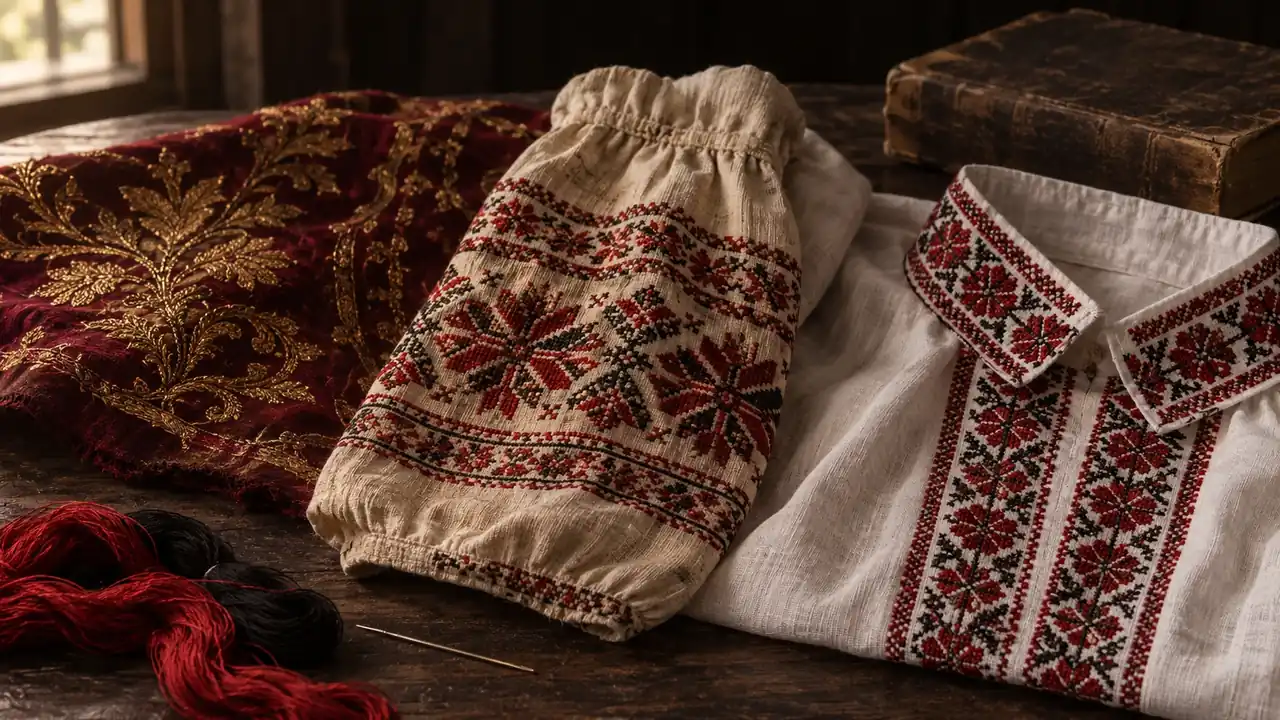
The word names a shirt of Ukrainian traditional dress embroidered where the fabric shows most: on the chest panel (pazukha), the collar, the sleeves and the cuffs. Pattern, technique and colour depend on the region, so each area has its own vyshyvanka history.
The origin of the vyshyvanka
Embroidered clothing was known in Ukraine from the princely era, but the vyshyvanka became a common peasant shirt much later. Exactly when is still debated.
What the Martynivka figurines really show
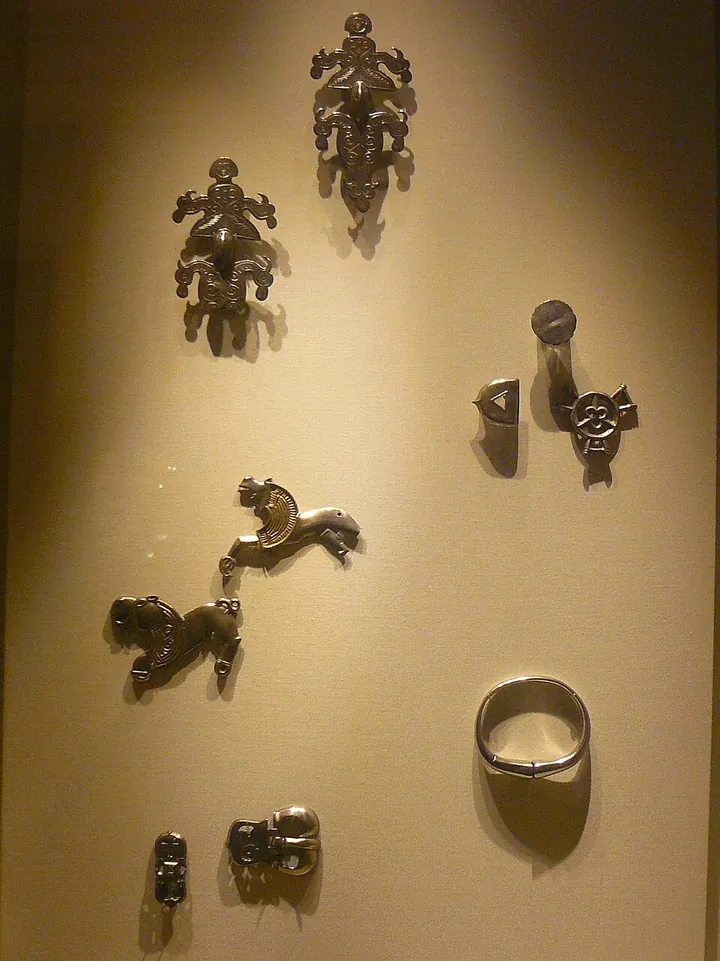
The history of the vyshyvanka is most often traced back to the Martynivka treasure, found around 1907 near the village of Martynivka in the Cherkasy region. It is dated to the 6th-7th centuries. Among the silver items are figurines of men with gilded clothing details, and in 1948 the archaeologist Boris Rybakov suggested they show embroidered shirts.
The ethnologist Oksana Kosmina disagrees: the decoration on the figurines may be appliqué or sewn-on trim, so the treasure cannot prove embroidered shirts in the 7th century. In this history the Martynivka treasure is a hypothesis, not evidence.
Gold on princely clothing
In Kyivan Rus embroidery was a luxury. Tetiana Kara-Vasylieva writes that gold embroidery developed widely at the time, and after Christianity was adopted, workshops at large monasteries and churches embroidered vestments, covers and icon towels.
The chronicle for 1086 mentions St Andrew's Monastery in Kyiv, founded by Yanka, daughter of Prince Vsevolod Yaroslavych. Historians of education write that it ran a school for girls who learned to read, sing and do crafts. Whether those crafts included embroidery, the sources do not say directly.
Oksana Kosmina told Ukrinform that from the 10th to the 18th century embroidery served the upper classes, and written mentions of embroidered items owned by the wealthy are known from the 16th century. How villagers embroidered in those times is barely known.
What Cossacks embroidered with
Clothing of the Cossack officer class was embroidered in silk and in gold and silver sukhozlitka, a metal thread. It was not for every day: it showed rank.
Five of the eight Zaporozhian Sich fortresses stood in what is now the Dnipropetrovsk region, and its museums keep clothing of hetmans and colonels. Silk and metal thread were also used there on rushnyky, tablecloths, pillowcases and church items. Alongside it, according to studies by Z. Marina and Kh. Kalyta, peasant families had their own geometric embroidery, so the Dnipropetrovsk region vyshyvanka has two separate roots. In the Chernihiv region the nobility of the Cossack Baroque also couched gold and silver thread onto imported fabric.
Folk embroidery of individual regions was taking shape at the same time. The researcher Oleksandra Holosna believes the ornament of the Sumy region vyshyvanka formed from the mid-17th century, when the area was being actively settled.
The history of the Ukrainian vyshyvanka in the 18th-19th centuries
These two centuries are when embroidery became usual on peasant clothing. Oksana Kosmina dates the shift to the end of the 18th century.
The oldest items in museums mostly come from this time too. The Chernihiv Historical Museum named after V. Tarnovsky keeps a rushnyk with the embroidered date 1746, probably the oldest dated piece of Chernihiv embroidery. Shirts in collections are mostly younger, from the late 19th and early 20th centuries. Cuts differed as well: tunic-style shirts, shirts with an ustavka shoulder piece and yoke shirts are described in our guide to the types of vyshyvanka.
How regional shirts differed
In the 19th century each region's vyshyvanka had its own materials and stitches. According to a study by Valentyna Tytarenko (2019), most Poltava shirts of the 19th and early 20th centuries are embroidered in white with added grey. The thread was dyed with oak and alder bark, elderberries and mulberries.
In the Yavoriv area shirts were sewn from grey homespun linen and embroidered with waxed linen thread in white and grey. In the Zhytomyr region the oldest technique was zanyzuvannia (running-stitch weaving), then satin stitch came, and from the mid-19th century cross-stitch. In the Mykolaiv region geometric forms dominated the ornament until the mid-19th century, while in the Donetsk region yoke shirts of factory cloth spread at the end of the century.
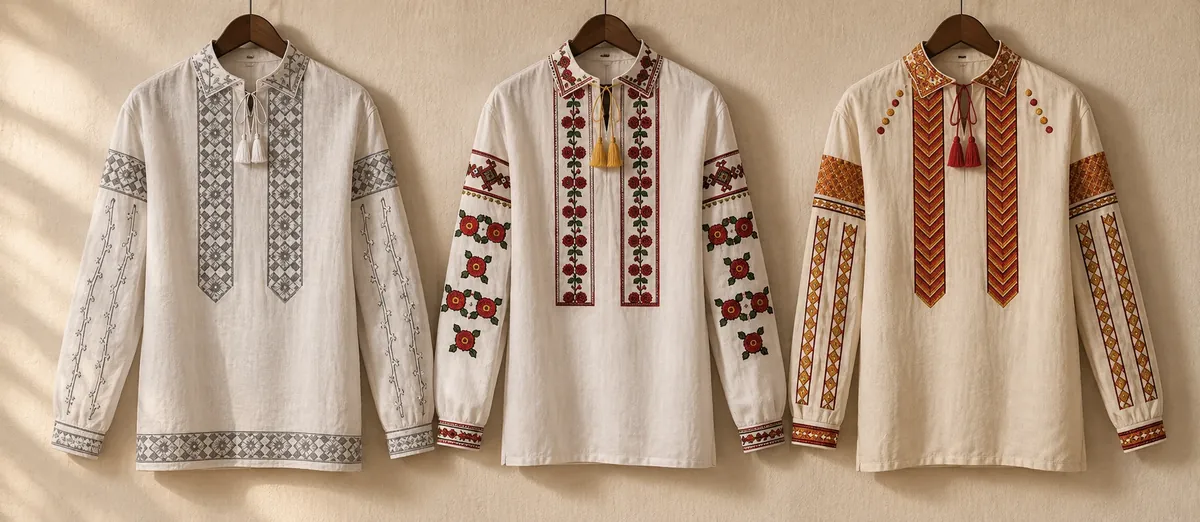
The vyshyvanka ornament took its own path in each area, and people could tell a place by its embroidery (compare them on the map of vyshyvankas by region of Ukraine). Folk embroidery also began to be collected as art. In 1876 Olena Pchilka published in Kyiv an album of patterns recorded in Volyn; its title was printed in Russian, "Ukrainskii narodnyi ornament" (Ukrainian Folk Ornament). At the end of the century cross-stitch spread: the folklorist Volodymyr Shchybria links it to pattern cards that the firm Brocard and Co. gave away with soap and perfume.
The history of the vyshyvanka in the 20th century
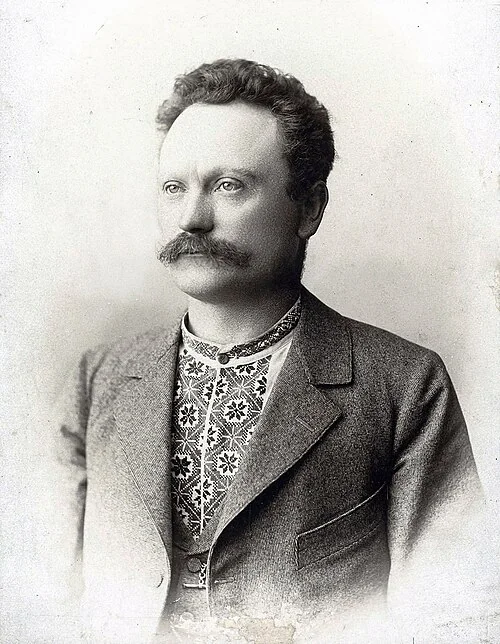
In the 20th century the vyshyvanka turned from peasant clothing into a sign of national identity. Ivan Franko wore an embroidered shirt under a jacket on weekdays and holidays alike, and Bohdan Tykholoz, director of the Franko House, explains it as the writer's deliberate choice.
The shirts changed as well. When factory cloth became available in the Lviv region, clothing began to be sewn in blue and black, and in Zakarpattia in the 1920s floral ornament spread through fashion magazines with patterns.
A shirt for a handful of grain
During the Holodomor of 1932-1933, according to the National Museum of the Holodomor-Genocide, people gave away embroidered shirts and rushnyky in exchange for a handful of grain or a few potatoes. The museum collects and digitizes clothing and towels that survived those years.
Factories and dissidents
In Soviet times vyshyvankas were also made in factories: in the 1960s-1980s the Shevchenko production association worked in Kyiv, and according to the researcher A. Varyvonchyk its embroidery was exported to the USA, Canada and Japan. According to the historian Oleksandr Alfiorov, in the 1970s and 1980s the embroidered shirt became an attribute of the dissident movement.
The Ukrainian vyshyvanka today and its history
Today the vyshyvanka is a symbol of Ukraine, a status reinforced by a holiday and by state recognition of regional embroidery traditions.
The history of Vyshyvanka Day
Vyshyvanka Day was founded in 2006 by Lesia Voroniuk, a student at Chernivtsi National University. It falls on the third Thursday of May, and according to the founder, speaking to Ukrinform, it is celebrated in more than 100 countries.
What is on the National List
Ukraine's National List of Intangible Cultural Heritage includes Reshetylivka embroidery (2017), Borshchiv folk embroidery and the Klembivka shirt of the Vinnytsia region (both 2020). Since 2023 it has also included the tradition of embroidering women's shirts in the Hadiach area. The Crimean Tatar ornament ornek joined UNESCO's Representative List in 2021. What the signs on these shirts mean is explained on our page about Ukrainian embroidery symbols.
Bringing back lost techniques
Some old vyshyvanka techniques had to be rebuilt almost from scratch, using museum pieces. Viktoriia Kryvonis, head of the Borshchiv Folk Shirt School, says that of roughly 250 embroidery techniques documented in Ukraine, more than 60 appear in the Borshchiv shirt.
Vyshyvankas during the war
Since 2022 vyshyvankas have had to be rescued again. During the occupation of Kherson, Russian forces looted the local history museum, which held a large part of the region's embroidery samples. After the Kharkiv region was liberated, a soldier, as Ukrinform reported, carried vyshyvankas and rushnyky out of a damaged school ethnographic museum, and on 18 May 2023 they were shown at an exhibition in Chernivtsi. In the Occupied Heritage project more than 20 craftspeople and researchers recreated 12 costumes of the Donetsk, Luhansk and other occupied regions, shown at the Ivan Honchar Museum.
A short history of the vyshyvanka
From ancient times to today, the history of the vyshyvanka comes down to a few dates. Disputed early dates are marked as hypotheses.
| When | What happened |
|---|---|
| 6th-7th c. | Martynivka treasure figurines; the "embroidered shirts" reading is a disputed hypothesis |
| Kyivan Rus | Gold embroidery develops; monastery workshops after the adoption of Christianity |
| 1086 | Yanka's St Andrew's Monastery in Kyiv; per historians of education, a school for girls |
| 16th c. | First written mentions of embroidered items of wealthy people (per O. Kosmina) |
| 17th-18th c. | Cossack officers' embroidery in silk and metal thread; the Sumy ornament takes shape |
| 1746 | Probably the oldest dated rushnyk of the Chernihiv region |
| late 18th c. | Embroidery passes into peasant dress, per O. Kosmina |
| 1876 | Olena Pchilka's album of patterns ("Ukrainskii narodnyi ornament") |
| late 19th c. | Brocard cross-stitch spreads |
| 1912 | Olena Pchilka first uses the word "vyshyvanka" for a shirt |
| 1932-1933 | Holodomor: vyshyvankas and rushnyky traded for food |
| 1960s-1980s | The Kyiv Shevchenko association makes embroidered goods, some for export |
| 1970s-1980s | The embroidered shirt as a dissident sign (per O. Alfiorov) |
| 2006 | Vyshyvanka Day is founded |
| 2017-2023 | Regional embroidery traditions are added to the National List; ornek on the UNESCO list (2021) |
| since 2022 | Vyshyvankas evacuated and costumes of occupied regions recreated |
Frequently asked questions about the history of the vyshyvanka
When did the vyshyvanka appear?
Embroidered clothing was known in Kyivan Rus, where gold embroidery developed, and the vyshyvanka became a common peasant shirt later: the ethnologist Oksana Kosmina dates this to the end of the 18th century. There is no exact date, and the early centuries of the vyshyvanka's history are still debated.
Why were the first vyshyvankas made?
The first known embroidered items showed the owner's status. According to Oksana Kosmina, from the 10th to the 18th century embroidery served the upper classes, and Cossack officers' clothing was embroidered in silk and metal thread to show rank. Reading embroidery as a protective charm is a later folk interpretation.
What thread was used in Cossack vyshyvankas?
Cossack officers' embroidery used silk and gold and silver sukhozlitka, a metal thread. It can be seen on the clothing of hetmans and colonels in museums of the Dnipropetrovsk region. These sources say nothing about the shirts of ordinary Cossacks.
Was there a vyshyvanka in Kyivan Rus?
Embroidered clothing existed in Kyivan Rus, but mostly as gold embroidery for the nobility and the church, which the art historian Tetiana Kara-Vasylieva describes. A long embroidered shirt was called a sorochytsia, and no peasant shirts from that time survive.
Who created the vyshyvanka?
Generations of embroiderers created the vyshyvanka, and each region developed its own techniques and ornaments. A few names stand out. According to the Museum of Folk Architecture and Rural Life in Lviv, Olena Pchilka first used the word "vyshyvanka" in 1912. Lesia Voroniuk founded Vyshyvanka Day in 2006.
What do legends about the vyshyvanka and the rushnyk have in common?
Folk tradition links both the vyshyvanka and the rushnyk to weddings and family. In Volyn the bride was expected to embroider the groom's shirt herself, and birds on a wedding rushnyk, according to a tradition recorded in the Donetsk region, wished happiness to the young family. More on these rites is in our article on the Ukrainian rushnyk, its types and meaning.
Is the vyshyvanka thousands of years old?
Embroidery in Ukraine is old, but sources do not show an unbroken history of the shirt over thousands of years. The claim usually rests on the 6th-7th century Martynivka treasure, but Boris Rybakov's reading of embroidered shirts on the figurines is disputed by Oksana Kosmina: the decoration may be sewn-on trim.
Is the vyshyvanka known outside Ukraine?
Yes, mostly thanks to Vyshyvanka Day: Lesia Voroniuk told Ukrinform that it is celebrated in more than 100 countries. From the 1960s embroidery of the Kyiv Shevchenko association was exported to the USA, Canada and Japan, and the Crimean Tatar ornek was added to UNESCO's Representative List in 2021.
How did the vyshyvanka become a symbol of Ukraine?
Gradually. Ivan Franko wore it under a jacket on weekdays and holidays. In the 1970s and 1980s, according to the historian Oleksandr Alfiorov, it became an attribute of dissidents. Vyshyvanka Day was founded in Chernivtsi in 2006, and since 2017 regional embroidery traditions have been added to Ukraine's National List of Intangible Cultural Heritage.
Sources
- Музей народної архітектури та побуту у Львові імені Климентія Шептицького. «Як правильно називати вишиту сорочку?» (Олена Пчілка, «Українські узори», 1912; сороциця).
- Косміна О. Інтерв'ю: Укрінформ («Оксана Косміна, етнологиня»); ZAXID.NET, «Правда і вигадки про українські вишиванки», 2020.
- Мартинівський скарб (Вікіпедія); думка Б. Рибакова (1948) про вишиті сорочки на фігурках.
- Кара-Васильєва Т. Доповідь на IV французько-українській археологічній конференції (золоте шитво Київської Русі).
- Попова, Парфанюк. Історія української вишивки. Матеріали конференції Хмельницького національного університету, 2023.
- Регіональні приклади - з перевірених матеріалів VyshyvankaDaily про регіони: В. Титаренко (2019, Полтавщина), Музей народної архітектури та побуту у Львові (Яворівщина), матеріали Житомирщини, Миколаївщини й Донеччини.
- Повість временних літ (1086, Андріївський монастир Янки); ZN.UA, «Янчин монастир»; osvita.ua (школа Янки).
- Маріна З. П. Українська вишивка ХІХ - початку ХХ ст. на Катеринославщині, 2013; Калита Х. Народна побутова вишивка (кінець XVIII - початок ХХІ ст.). Дніпропетровщина: фотоальбом, 2016.
- Чернігівський історичний музей імені В. Тарновського; «Вишивка Чернігівщини» (Родовід).
- Голосна О. С. Історія української вишиванки на Сумщині, 2017.
- Волинський краєзнавчий музей і Колодяжненський музей Лесі Українки: перевидання альбому О. Пчілки 1876 року.
- Суспільне: В. Щибря (брокарівська вишивка); Радіо Свобода: Б. Тихолоз (Іван Франко); В. Коцан (Закарпатський музей народної архітектури та побуту); А. Варивончик (КНУКіМ).
- Національний музей Голодомору-геноциду (колекція одягу й рушників).
- Телеграф, 2024: історик О. Алфьоров про вишиванку в радянські роки.
- Національний перелік елементів нематеріальної культурної спадщини України; ЮНЕСКО, орьнек (2021).
- Суспільне Тернопіль, 2025: В. Кривоніс («Школа борщівської народної сорочки»); Укрінформ (евакуація вишиванок з Харківщини, виставка в Чернівцях 18.05.2023); Херсонський краєзнавчий музей; Музей Івана Гончара, проєкт «Окупована спадщина».
- Укрінформ, інтерв'ю з Лесею Воронюк (День вишиванки); Л. Мірошниченко-Гусак, Волинський краєзнавчий музей (весільне вбрання); весільна традиція Донеччини - за джерелами статті про український рушник.
If you notice a mistake, please let us know.