Dnipropetrovsk Oblast
◇ DocumentedContents
- Two kinds of embroidery in one land
- Dnipropetrovsk Oblast embroidery ornament: the geometry of the steppe
- Yavornytskyi and the Katerynoslav collection
- How many techniques there really are
- Colours and decoration
- The steppe is not uniform
- Katerynoslav rushnyky: the tree of life, birds and eagles
- From cutwork to Petrykivka satin stitch
- Frequently asked questions
- Articles about this region
- Embroidery motifs
- Dominant colors
- Sources
Dnipropetrovsk embroidery developed along two lines: the costly work of the Cossack officer class in silk and gold and silver thread, and the geometric folk embroidery of peasant families. The folk tradition is defined by the density of signs: crosses, solar signs, stars, triangles and squares on a single shirt.
Of the eight Zaporizhzhian Sichs that existed in the Cossack era, five were located on the territory of today's Dnipropetrovsk region. So the Dnipropetrovsk vyshyvanka developed in two directions at once.
Two kinds of embroidery in one land
The region's museum collections preserve the dress of the Cossack officer class - hetmans and colonels. Sheets, pillowcases, tablecloths, rushnyky, clothing and church items were embroidered with silk thread and gold and silver metal leaf. This precious work was made to display rank rather than for everyday wear, and museums show it most often.
The simple folk embroidery of the same lands is a completely different tradition. The precious dress of the officer class and the geometric embroidery of peasant families coexisted on one territory, but they should not be confused: they are two different worlds with different materials and purposes.
The folk line is in no way poorer in design. Its expressiveness was built not on precious thread but on the complexity of the design itself.
Dnipropetrovsk Oblast embroidery ornament: the geometry of the steppe
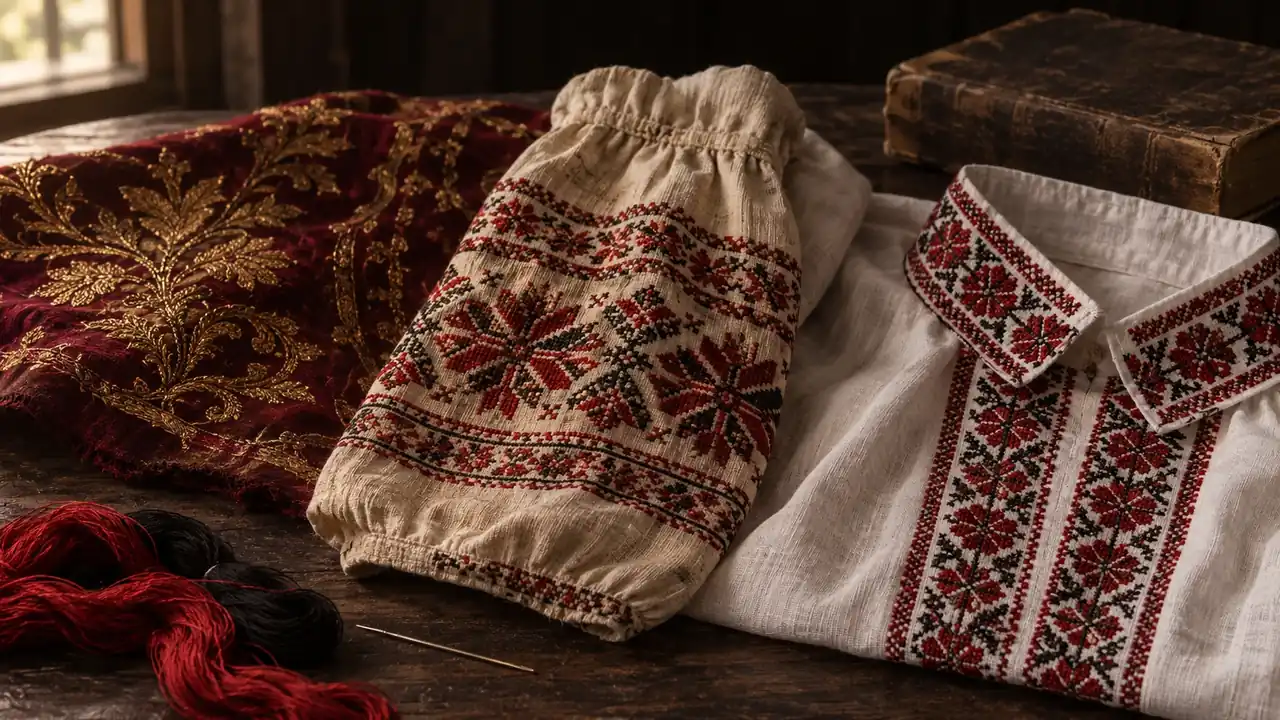
The region's folk tradition holds a great variety of geometric symbols: crosses, diagonal crosses, solar signs, stars, triangles and squares in various combinations. A single shirt could carry more different symbols than some regions have in their entire tradition. Dnipropetrovsk embroidery ornament is defined by this density of signs, not by a single distinctive motif.
On shirts, plant motifs often take on a strict geometric character: a flower that enters this system turns into a set of straight lines. But on the region's rushnyky, as Z. Maryna's study below shows, floral and plant ornament prevailed, complemented by geometric motifs.
Researchers record solar signs in geometric forms in many regions, so this is not a local invention. In Zaporizhzhia the same principle is embodied in the circle with a rosette: a tradition shared across the steppe takes its own shape in each region.
Yavornytskyi and the Katerynoslav collection
The region's most important documentary source is linked to Dmytro Yavornytskyi - the historian and founder of the museum that bears his name today. The researcher Maryna Pidosynova described the folk embroidery of the Katerynoslav region using materials from his collection, and our description of the Dnipropetrovsk Oblast vyshyvanka rests on this study.
Katerynoslav region is the historical name of the land before it was renamed Dnipropetrovsk region, and the collection was assembled and studied under that name. Few steppe regions have embroidery that can be tied to a specific archive.
With a known collector and the land's old name, Dnipropetrovsk embroidery can be described more concretely than most steppe traditions.
How many techniques there really are
According to folk artist Oksana Tyzhnenko, the total number of techniques used to embroider the Ukrainian shirt exceeds 200, and a single Dnipropetrovsk vyshyvanka could combine up to seven different methods. The most widespread was lyshtva - straight satin stitch. Merezhka drawn-thread work, used to create lace, and cutwork were also especially popular here.
In 2024 the Dnipro brand HISTROV recreated Ivan Franko's vyshyvanka - the very one in which the writer is portrayed on the twenty-hryvnia banknote. The region's museum collection numbers about three thousand embroidered items: shirts, rushnyky, headscarves, pillowcases and even embroidered icons.
Colours and decoration
In the men's shirt red and black prevailed - a restrained, contrasting pair typical of the steppe regions. Cuffs and the neckline were decorated with coloured thread and black velvet. This detail is absent from descriptions of neighbouring regions, and it lets you recognise a Dnipropetrovsk vyshyvanka before you even look at the ornament.
Velvet here is no longer embroidery but a separate sewn-in material: the tradition was not limited to thread and linen where a different effect was wanted. Such details rarely appear in popular descriptions, although they are documented in museum catalogues.
The steppe is not uniform
The Dnipropetrovsk, Zaporizhzhia, Kherson and Mykolaiv regions share a similar red-and-black basis but differ in the scale of the pattern. Scale is the easiest way to tell the neighbours apart, even without knowing the symbolism of each sign.
| Region | Character of the ornament |
|---|---|
| Dnipropetrovsk region | small dense geometry, many symbols at once |
| Zaporizhzhia | large simple forms, readable from afar |
| Kherson region | plant and floral motifs, animals, black-and-white contrast |
| Mykolaiv region | highly stylised plant forms, little pines, oak leaves |
The Dnipropetrovsk region is the most geometric and the densest: where Zaporizhzhia offers large simple forms, here fine detailing with many symbols at once is at work. This is what sets Dnipropetrovsk embroidery ornament apart from the other steppe traditions.
Katerynoslav rushnyky: the tree of life, birds and eagles
Researcher Z. Maryna (2013) summarised the embroidery of the Katerynoslav region in the 19th and early 20th century using the collections of the Yavornytskyi History Museum in Dnipro, the art museum, the Kryvyi Rih and Dniprodzerzhynsk (now Kamianske) museums of local history and the ethnography room of Dnipro National University. On the oldest rushnyky of the late 18th and early 19th century single-colour embroidery in hand-spun red thread dominates, less often red with light blue. The embroidery covers about a third of the length at each end, while the middle stays free.
The main subject is the tree of life growing from a vase, sometimes as a stylised female figure, with doves, roosters, peacocks and ducks on and above its branches. According to Maryna, T. Kara-Vasylieva noted that the Dnipropetrovsk rushnyk differs from the Poltava one by adding black and yellow to red. Double-headed eagles were often embroidered next to the world tree, and a drawn-thread band 40-45 centimetres wide on a wedding rushnyk is, according to Maryna, a feature of this region.
From cutwork to Petrykivka satin stitch
At the beginning of the 20th century ethnographer V. Babenko recorded dozens of techniques in villages of the governorate: cutwork (Pereshchepyne, Borodaivka, Kutsevolivka), "millstone cutwork", "cross cutwork", satin stitch, cross-stitch, "pig's path" and "little spider". Museum collections also hold "shabak" drawn-thread work, "chicken feet", "backstitch with ram's horns" and "little towns". From the mid-19th century "obmanka", or "false cutwork", spread, and Brocard cross-stitch later displaced most of the old stitches, although the colours and subjects of Dnipropetrovsk embroidery stayed local.
In the northern districts of the governorate plant ornament was embroidered mostly in red and black (the black turns grey over time), in the Kryvyi Rih area with added yellow: realistic grapevines, oak leaves and acorns, roses, lilies, guelder rose and poppies. At the end of the 19th century Petrykivka, or double-sided, satin stitch appeared near Petrykivka, in crimson, blue, green, pink, light blue and burgundy thread against brown or ochre. A collection of 44 Petrykivka rushnyky gathered in the 1970s is kept in the Zaporizhzhia art museum.
Frequently asked questions
Is the region's embroidery directly linked to the Cossacks?
Partly. Five of the eight Zaporozhian Sichs stood on the territory of the region, and museums hold garments of the Cossack officer class embroidered in silk and gold and silver foil thread. But that is a separate, status tradition. The folk geometric embroidery of peasant families developed in parallel, from different materials and by a different logic.
Who was Yavornytskyi and why does he matter here?
Dmytro Yavornytskyi was a historian and the founder of the museum that bears his name today. His collection became the basis on which the researcher Maryna Pidosynova described the folk embroidery of the Katerynoslav region, as the area was then called.
Why do the patterns have so many symbols at once?
Because Dnipropetrovsk embroidery is built not on one recognisable motif but on a whole system of geometric signs: crosses, stars, solar symbols, triangles and squares. On shirts even flowers often become a set of straight lines, although on rushnyky the plants stayed recognisable.
What is Petrykivka satin stitch in embroidery?
A double-sided satin stitch that appeared at the end of the 19th century in villages near Petrykivka. According to Z. Maryna's study, it is marked by bright crimson, blue, green, pink and burgundy thread against brown or ochre, and its main motif is the tree of life with grapes, oak leaves and garlands of flowers.
If you notice a mistake, please let us know.

Gallery
Articles about this region
Embroidery motifs
The generator builds this region's vyshyvanka from these motifs, combining them differently every day. What the symbols mean
Chest and collar
Sleeve
Borders
- Wave
Dominant colors
Also found
The main colors of this region's pattern, not a complete list of every shade found in real embroidery.
Updated:
Sources
-
Народна побутова вишивка (кінець XVIII - початок ХХІ ст.). Дніпропетровщина: фотоальбом
- Калита Х. / Дніпровська обласна наукова бібліотека
(2016)
2016. -
Українська вишивка ХІХ - початку ХХ ст. на Катеринославщині
- Маріна З.П.
(2013)
Історія і культура Придніпров'я: невідомі та маловідомі сторінки, 2013, вип. 10, с. 121-128.