Ternopil Oblast
◇ DocumentedContents
- How much of the seven-generations legend is true
- Wool, not cotton: what the Ternopil vyshyvanka is made of
- Ternopil embroidery ornament: motifs and composition
- How the tradition was brought out of the chests
- Where to see the originals
- Borshchiv among the western traditions
- The shirt of the Kormysh brothers
- The School of the Borshchiv Folk Shirt
- From Kryvche to Okopy: shirts village by village
- Frequently asked questions
- Articles about this region
- Embroidery motifs
- Dominant colors
- Sources
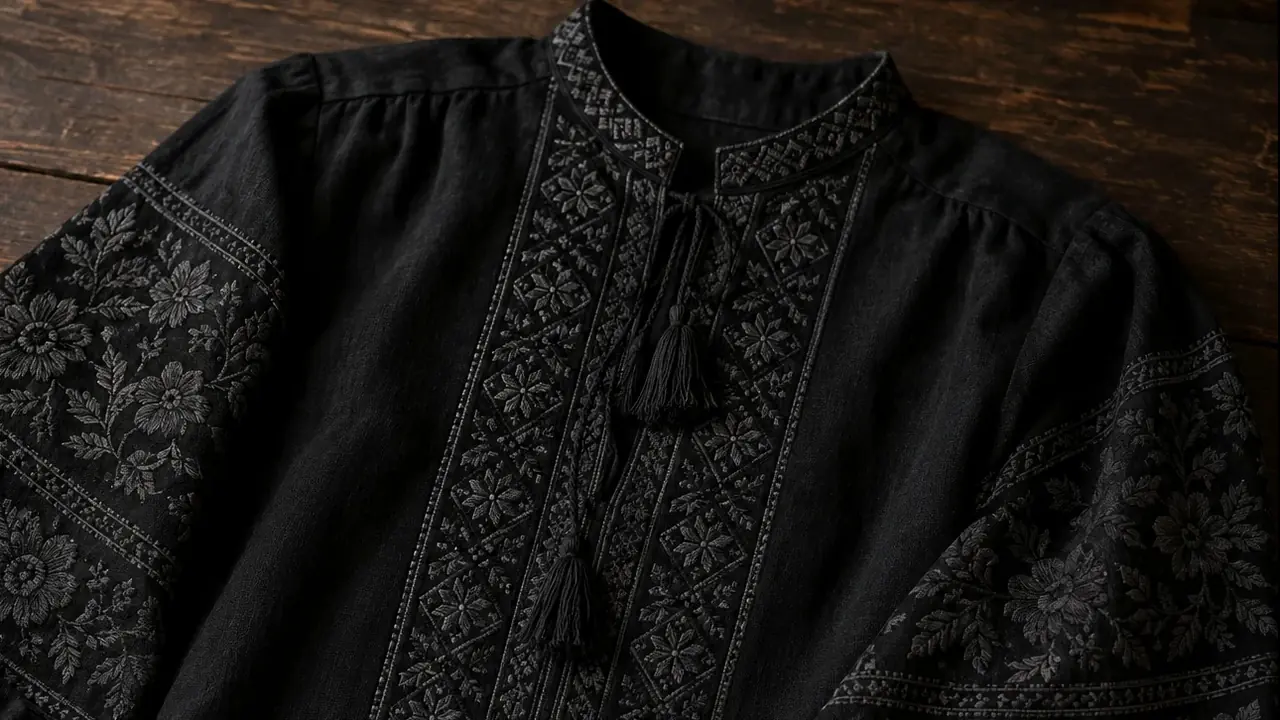
Ternopil embroidery means, above all, the Borshchiv shirt: a sleeve almost entirely covered in woollen thread, dominated by black, with motifs outlined in colour, most often red. In 2020 Borshchiv folk embroidery was added to Ukraine's National List of Intangible Cultural Heritage.
Almost everyone tells the same story about this shirt: the black colour is mourning for the men taken by the war with the Turks, and it was worn for seven generations.
It is a beautiful story. That does not make it documented. This is how the Borshchiv vyshyvanka is most often described. Ternopil and the whole region know the tale by heart, even though nothing confirms it.
How much of the seven-generations legend is true
There are several tales about the origin of the black colour, and none of them is directly confirmed by sources. We present them as tales, not as historical fact.
What can be stated with confidence is this. Black dominated mainly in the northern part of the area, and shirts made before the 1930s really do have more of it. The older the piece, the darker it tends to be.
So the pattern exists, but the explanation may be more prosaic than the legend: the availability of dyes, local fashion, the influence of neighbouring centres. We do not know for certain, and the Ternopil vyshyvanka remains an example of how a tale can replace a document over time.
Wool, not cotton: what the Ternopil vyshyvanka is made of
The main technical feature, usually left unmentioned: the Borshchiv shirt was embroidered mostly with woollen thread.
That changes everything. Wool is thicker than cotton, lies with more volume and gives a dense relief that makes the sleeve look almost completely covered. It holds colour differently and fades differently over time. It is the wool, not just the number of stitches, that makes the Borshchiv shirt so recognisable to the touch and to the eye.
The tradition lives in the area of the former Borshchiv and Zalishchyky districts. It has several names: the Borshchiv shirt, the Borshchiv vyshyvanka, or simply borshchivka. In 2020 Borshchiv folk embroidery was added to the National List of Intangible Cultural Heritage.
Ternopil embroidery ornament: motifs and composition
The patterns here follow a regular composition rather than random placement: the design is built on a rule that repeats along the whole sleeve.
A favourite motif is the guelder rose between two birds. It appears in various forms and belongs to the plant-and-animal group. The meaning of the guelder rose and the birds is interpreted differently by different authors, so we do not present any single version as the only correct one.
The black mass does not stay solid: the patterns are outlined with coloured contours, most often red. Without them the design would merge into a single patch, and Ternopil embroidery would lose its legibility.
How the tradition was brought out of the chests
Only a few decades ago the Borshchiv shirt existed mostly in family chests rather than in public view.
This was changed by the collector Vira Matkovska, who began collecting dress as a student and assembled a collection of more than a thousand items. She also founded the Borshchiv shirt festival, where villages come dressed in what has survived. Matkovska is reviving the craft as well: she commissions women from villages along the Dniester to stitch old patterns onto modern shirts and blouses.
Her collection has been exhibited at Mystetskyi Arsenal and the Ukrainian House in Kyiv, the National Museum of Hutsul and Pokuttia Folk Art in Kolomyia, the Ternopil Art Museum, and in France, Germany, Poland, Greece, Lithuania, Latvia and Slovenia. Thanks to this, Ternopil embroidery is no longer a purely local phenomenon.
Where to see the originals
The Borshchiv Local History Museum keeps a collection of old women's shirts and shows them during the annual "Borshchiv Vyshyvankas" festival.
The Ternopil Regional Museum of Local History holds exhibitions of Borshchiv embroidery and workshops, including as part of the conference "Borshchiv Folk Embroidery: A Link Between Generations". So Ternopil embroidery can be seen both behind glass and in the making.
Borshchiv among the western traditions
Western Ukraine only looks uniform. Four neighbouring regions show four different characters, and the Ternopil vyshyvanka stands at the far end of the scale for density.
- Ternopil region (Borshchiv area) - maximum density, black wool, an almost completely covered sleeve
- Lviv region (Sokal area) - the opposite: a lot of bare linen, a lace effect
- Ivano-Frankivsk region - geometric figures merge into one dynamic line, a warm autumn palette
- Chernivtsi region - diagonal stripes, silver and gold thread, beads
The quickest way to tell the first two apart: look at how much linen has been left bare.
The shirt of the Kormysh brothers
In 2022 the Borshchiv Museum of Local History presented a shirt that belonged to Vasyl Kormysh, born in 1914 in the village of Pyshchatyntsi, a member of the OUN. His sister Mariia Sviientakh embroidered it for her brother around the mid-1930s and kept it in a chest after his death in 1949. It was given to the museum by Mariia's granddaughter, museum researcher Natalia Nykolyn, who recorded the family's story. For the Ternopil vyshyvanka this is a rare case where the owner, the embroiderer and the approximate date are all known.
The School of the Borshchiv Folk Shirt
The tradition is alive today. In 2023, at the Ternopil Museum of Local History, 22 embroiderers of the "School of the Borshchiv Folk Shirt" civic organisation showed their work in the style of old Borshchiv embroidery: shirts recreated from sketches or embroidered from new charts, as well as rushnyky, necklaces and beaded syliankas. The head of the organisation, Viktoriia Kryvonis, told Suspilne that the work also includes shirts from other regions of Ukraine.
From Kryvche to Okopy: shirts village by village
Borshchiv folk embroidery was added to the National List of Elements of Intangible Cultural Heritage by an order of 13 October 2020. Among its centres the list names Borshchiv, the villages of Kryvche, Ivane-Puste, Hermakivka, Strilkivtsi, Melnytsia-Podilska, Dnistrove and Yuriampil, while bearers of the tradition also live in Terebovlia, Lviv, Rivne, Kyiv, Zaporizhzhia and even the USA.
According to Roman Yakel's article in Dzerkalo Tyzhnia (2018), the Borshchiv Museum of Local History keeps more than a hundred embroidered shirts, women's, men's and children's, the oldest from the late 19th and early 20th century. The pattern often tells you the village: floral ornament prevails in Kryvche and Hermakivka, while in Vyhoda, Trubchyn, Bilivtsi and Okopy luxurious shirts with geometric figures were embroidered in the 1920s and 1930s. Among the techniques of the Borshchiv Ternopil vyshyvanka the author names kolodka, drawn-thread work, zapoloch, verkhoplut, kasator and beadwork.
Viktoriia Kryvonis, who has taught Borshchiv embroidery since 2016, counts more than 60 techniques in the Borshchiv shirt out of about 250 studied in Ukraine. Classes are held at the museum twice a month: she draws the charts, and museum researcher Halyna Zavisha writes the descriptions. One shirt, she says, took about fifteen years to study.
Frequently asked questions
Is it true that the black colour stands for mourning?
It is a legend, not a confirmed fact. There are several stories about seven generations mourning the men lost in the war with the Turks, and none has direct support in the sources. What is documented is different: black really did dominate in the north of the area and in shirts made before the 1930s.
Are the Borshchiv shirt and the Ternopil shirt the same thing?
Not quite. The Borshchiv shirt comes from the former Borshchiv and Zalishchyky districts in the south of the region, and the Ternopil region is wider than that area. But it was the Borshchiv type that made the tradition recognisable, so a Ternopil vyshyvanka most often means this type.
Why were the shirts embroidered with wool?
Because wool is thicker than cotton and lies with more volume. It gives the dense relief that makes the sleeve look almost completely covered in stitching, and that is how a Borshchiv shirt is recognised.
How old is this tradition?
The surviving shirts date from the 19th and 20th centuries. What came before the 19th century is far less well documented, so researchers are cautious in their conclusions.
How long did one shirt take?
Nobody recorded exact figures. But covering a whole sleeve in wool is months of work, not a few evenings, so such a shirt was valued and handed down.
Where can you see modern Borshchiv shirts?
They are embroidered by members of the "School of the Borshchiv Folk Shirt" civic organisation. In 2023, 22 of them showed their work at the Ternopil Museum of Local History, and the Borshchiv Museum of Local History keeps old shirts too, including Vasyl Kormysh's shirt from the 1930s.
How many techniques are there in a Borshchiv shirt?
According to teacher Viktoriia Kryvonis, more than 60 of the roughly 250 embroidery techniques studied in Ukraine. They include kolodka, drawn-thread work, zapoloch, verkhoplut, kasator and beadwork.
If you notice a mistake, please let us know.

Gallery
Articles about this region
Black vyshyvanka: what black meant on a shirt, region by region
20 interesting facts about the Ukrainian vyshyvanka, plus 4 myths
Embroidery motifs
The generator builds this region's vyshyvanka from these motifs, combining them differently every day. What the symbols mean
Chest and collar
Borders
Dominant colors
Also found
The main colors of this region's pattern, not a complete list of every shade found in real embroidery.
Updated:
Sources
-
Українська народна вишивка. Західні області УРСР
- Захарчук-Чугай Р.В.
(1988)
К.: Наукова думка, 1988. -
Національний перелік елементів нематеріальної культурної спадщини України
- Міністерство культури та інформаційної політики України
(2023)
Борщівська народна вишивка - наказ від 13.10.2020 № 2182; вишивка «білим по білому» Решетилівки - наказ від 29.06.2017 № 561; вишивка жіночої сорочки на Гадяччині - наказ від 12.07.2023 № 380; клембівська сорочка «з квіткою» - наказ від 13.10.2020 № 2182. Орьнек - кримськотатарський орнамент та знання про нього - наказ від 12.02.2018 № 105.