Khmelnytskyi Oblast
◇ DocumentedContents
- The Zinkiv area on the verge of disappearing
- Names you will not find anywhere else
- Khmelnytskyi embroidery ornament: the cutwork technique
- A museum with 172,000 items
- Colours of Khmelnytskyi embroidery
- The Khmelnytskyi and Vinnytsia regions: two faces of Podillia
- The blue shirts of Zinkiv
- The cut of the Podillian shirt from museum holdings
- Frequently asked questions
- Articles about this region
- Embroidery motifs
- Dominant colors
- Sources
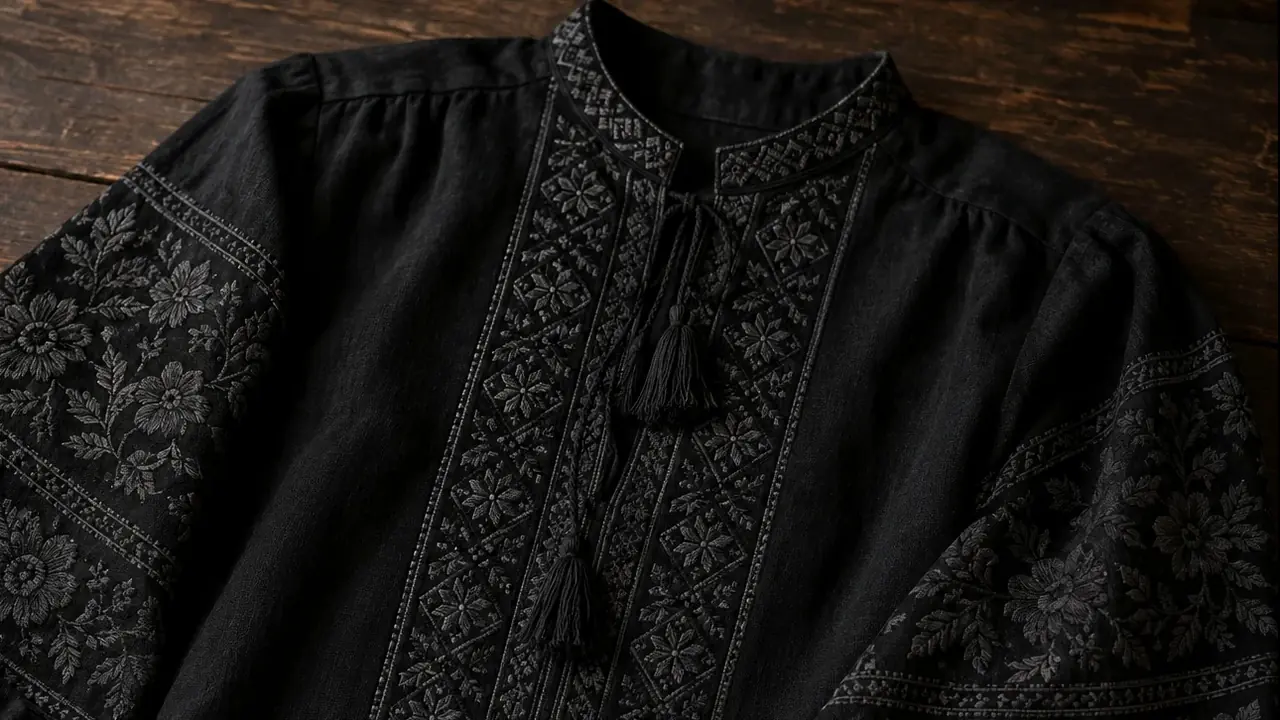
Khmelnytskyi embroidery is the most austere of the Podillia traditions: strict geometric nyz of straight, slanting and serrated lines with no plant elements, while single-colour shirts were made in cutwork. Many local pattern names, such as semyrih and bezkonechnyk, survive thanks to Yukhym Sitsynskyi's collection.
In one village of the Zinkiv area, a single embroiderer is left who still stitches shirts from the old patterns. If the tradition is not passed on, it will disappear. That is where the story of the vyshyvanka of Khmelnytskyi and the whole region begins.
The Zinkiv area on the verge of disappearing
This is not an isolated case for Ukraine, but for the Khmelnytskyi region it is telling: much of what we know about the regional vyshyvanka rests on very few living bearers of the technique rather than on a mass tradition that passes itself on through generations without special effort.
So museum collections and research catalogues are what save the patterns here. Without them, part of the knowledge about the region would disappear along with the last people who still remember it, and the local ornament would be known only in fragments.
Names you will not find anywhere else
The collection of the researcher Yukhym Sitsynskyi, compiled at the turn of the 19th and 20th centuries, preserves dozens of local Podillian names for ornaments: "steep horns", "seven horns", "endless", "kryvulka" - named after the character of the technique; "little pine", "oat", "burdock", "pheasant's eye", "little hops", "parsley", "beans", "rue", "little apples", "plums" - named after plant motifs. None of these terms appears in official descriptions of local embroidery outside this particular collection.
These names were used in everyday speech long before embroidery began to be classified scientifically. Without a record they would have disappeared with the last embroiderers who remembered them, and no later researcher could have restored them.
Thanks to such records, vyshyvankas of Khmelnytskyi Oblast can be studied in detail: we know both what the ornament looked like and what the people who wore it called it.
Khmelnytskyi embroidery ornament: the cutwork technique
The region's single-colour shirts were made with the cutwork technique - some threads of the linen are removed and the gaps are finished. A mistake here cannot be undone: you cannot put a thread back, so the embroiderer had to plan everything in advance. This is how the local single-colour shirts in museum collections were made.
The basis of the pattern is strict geometric nyz: straight, slanted, broken and toothed lines, with no plant elements even in geometric form. Of all the regions we describe, this is the most ascetic tradition, and the vyshyvanka of the Khmelnytskyi land is considered the benchmark of Podillian minimalism.
A museum with 172,000 items
The Kamianets-Podilskyi State Historical Museum-Reserve was founded in 1890. Today it brings together eight locations - the Old Castle, the Town Hall, the Art Gallery, the Museum of Antiquities and others - and holds 171,852 items, of which almost 150,000 belong to the main collection.
In the ethnography department, the region's embroidery is shown alongside pottery, blacksmithing and woodcarving, presented in a staged setting together with the other crafts.
Colours of Khmelnytskyi embroidery
The most common shirts here are embroidered entirely in black or entirely in red, without mixing. One colour dominates, and touches of others stay secondary. This distinguishes vyshyvankas of Khmelnytskyi Oblast from the neighbouring multicoloured Vinnytsia region.
In the generator the region's palette is built on black, red and blue, and it works as a dominant colour plus restrained additions rather than as a set of equal colours - the same principle that defines the whole Podillian minimalist tradition.
The Khmelnytskyi and Vinnytsia regions: two faces of Podillia
Both regions are Eastern Podillia, both rely on the same Sitsynskyi source, but they arrive at opposite solutions. This comparison shows well how different embroidery can be even within a shared cultural space.
| Region | Approach |
|---|---|
| Khmelnytskyi region | minimalism, one colour, pure geometry, the cutwork technique |
| Vinnytsia region | rhythmic alternation of colours in squares, at least six techniques at once |
Both approaches are equally legitimate versions of what a vyshyvanka could be next door to each other: a shared geographical and cultural basis produced two results that are almost opposite in complexity.
The blue shirts of Zinkiv
Svitlana Delikatna from Khmelnytskyi collects old shirts from different districts of the oblast, and her collection holds about 60 women's, men's and children's shirts. As she told Suspilne (2020), one shirt is missing: one embroidered in blue, or blue and green, thread. Such shirts were worn only in Zinkiv in the Vinkivtsi district and nearby villages. Local historian Valentyna Kohut, co-founder of the "Club of Keepers of Zinkiv History", confirms that Zinkiv shirts were embroidered in blue thread, green was also allowed, and such a pattern, cut and embroidery have been found nowhere else. The museum of the Zinkiv school complex keeps a shirt embroidered about 200 years ago.
Among the districts of the oblast the collector singles out Nova Ushytsia: "a superb pattern, a restrained palette". Shirts from the Slavuta district, which leans towards Volhynia, stand out for their collars and patterns not typical of Podillia. So the Khmelnytskyi vyshyvanka is at least two worlds, Podillian and Volhynian.
The cut of the Podillian shirt from museum holdings
Researchers of Khmelnytskyi National University I. Zasornova and O. Selska, together with A. Mychko (2016), studied women's shirts in the holdings of the Khmelnytskyi Regional Museum of Local History and identified two main types: "with inserts" and "without inserts". The insert was an underarm gusset in the shape of a rhombus, square or rectangle. According to an old belief, the crossing of four seams at this point carried negative energy, so the insert was meant to protect. Later the simpler cut without an insert spread.
The front was cut in one piece or in two: the top from softer, finer linen, the bottom from thicker cloth. The neckline could be rectangular, square, oval, round or trapezoid, the collars standing or turn-down. A shirt usually reached the ankles, since the longer the shirt, the more respectable a girl was considered. The researchers also note a clear interaction with the Moldovan tradition in colour and cut, since Podillia always bordered Moldova.
Frequently asked questions
Can you still learn Zinkiv embroidery?
For now, yes: in a village of the Zinkiv area there is still a craftswoman who embroiders from the old patterns. But she is the last one, and if the technique is not passed on to the next generation, it will only be possible to study it from museum pieces.
Why is Khmelnytskyi embroidery mostly single-coloured?
That is the local tradition: the most common shirts here are embroidered entirely in black or entirely in red. Other colours appear only as accents. The neighbouring Vinnytsia region, by contrast, alternates colours rhythmically in squares.
Where can I find the real names of Podillia ornaments?
In the collection of Yukhym Sitsynskyi, compiled at the turn of the 19th and 20th centuries and studied by Olena Klymchyk. It preserves the everyday names of patterns: "steep horns", "seven horns", "endless", "little oats", "pheasant's eye", "little beans" and dozens more.
Are there blue vyshyvankas in the Khmelnytskyi region?
Yes, in Zinkiv in the Vinkivtsi district and nearby villages shirts were embroidered in blue thread, with green also allowed. According to local historian Valentyna Kohut, such a pattern, cut and embroidery have been found nowhere else.
If you notice a mistake, please let us know.

Gallery
Articles about this region
Embroidery motifs
The generator builds this region's vyshyvanka from these motifs, combining them differently every day. What the symbols mean
Chest and collar
- Saw-tooth lines
- Rhombus within a rhombus
Dominant colors
Also found
The main colors of this region's pattern, not a complete list of every shade found in real embroidery.
Updated:
Sources
-
Подільські вишивки кінця ХІХ - початку ХХ ст., зібрані Ю. Сіцинським
- Климчик О.
(1993)
// Україна, 1993, №1. Колекція Кам'янець-Подільського історичного музею-заповідника. -
Класифікація конструктивних елементів українських національних сорочок Поділля
- Засорнова І.О., Сельська О.О., Мичко А.А.
(2016)
Вісник Хмельницького національного університету, 2016, № 3 (237), с. 272-276.