Chernivtsi Oblast
◇ DocumentedContents
- Not one Bukovyna, but several
- Chernivtsi Oblast embroidery ornament: from monochrome to roses
- The colours of Chernivtsi embroidery
- Embroidery that preserves memory
- Chernivtsi vyshyvankas and the Carpathian foothills
- Patterns recorded by Erich Kolbenhayer
- Bukovynian shirts in archives and museums
- Zmorshka, ustavka and field: how to read a Bukovynian sleeve
- Morshenka, salba and bunda: the dress of the Zastavna area
- Eight hundred shirts in the open air
- Frequently asked questions
- Articles about this region
- Embroidery motifs
- Dominant colors
- Sources
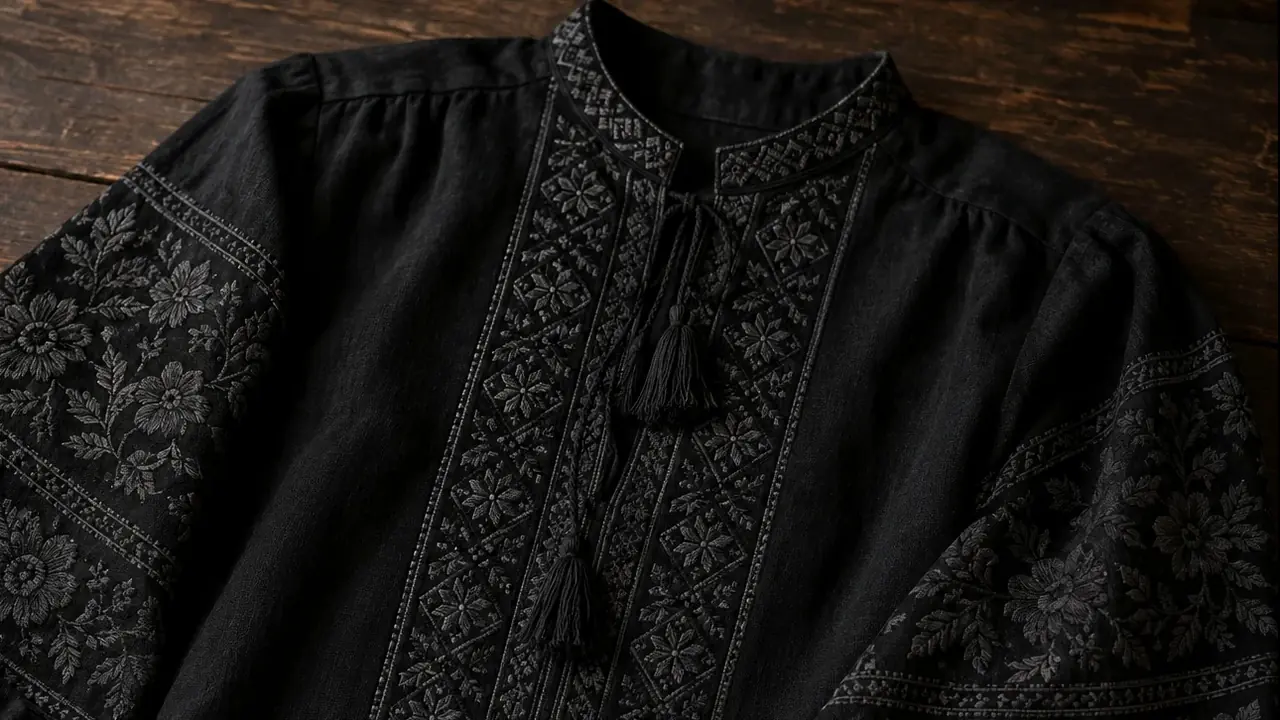
Bukovyna embroidery from the Chernivtsi region stands out for beads, sequins and metal thread and for complex compositions of floral and geometric motifs. The main palette is black and burgundy, and local schools differ: Zastavna favours yellow-green horizontal bands, Kitsman large bouquets of roses and birds.
"When I embroider, I keep silent and pray," the grandmother of Halyna, an embroiderer from Chernivtsi, used to say. Her granddaughter understood what that meant only years later. This phrase is where we begin the story of the vyshyvankas of Chernivtsi and all of Bukovyna.
Not one Bukovyna, but several
The lowland part of the region - the former Kitsman area and the villages along the Prut in the former Novoselytsia district - has a varied ethnic make-up, so embroidery differs from village to village, not just from neighbouring regions.
What these local schools share is complex ornamental compositions with a balanced mix of plant and geometric motifs, several techniques at once, and a prominent place for beads, sequins and metal leaf, which not every family could afford.
Chernivtsi Oblast embroidery ornament: from monochrome to roses
The oldest examples of Chernivtsi Oblast embroidery ornament are worked in a single colour - a general pattern shared by other archaic traditions of Ukraine. Then the tradition branches into local variants, and the description highlights the two most expressive of them.
In Zastavna yellow-and-green horizontal stripes prevail. In Kitsman, by contrast, large bouquets of roses and images of birds. The difference is significant: Zastavna keeps to a striped composition, Kitsman moves towards large figurative motifs. This is the easiest way to tell the embroidery of the two villages apart.
The colours of Chernivtsi embroidery
The main palette of Chernivtsi vyshyvankas is black and burgundy. The Zastavna variant adds yellow-and-green shades, and without them the region's palette would be incomplete, represented only by the Kitsman line.
Flat vector graphics cannot convey metallic thread and beads: the shine depends on how the material reflects light. This is a limitation of the generator, and we do not hide it.
Embroidery that preserves memory
Tetiana Minaieva, director of the Chernivtsi Museum of Local History, says the museum has repeatedly worked with museums from frontline cities - for some, embroidery became a heritage that had to be rescued from the war, for others it remains a collection that keeps the memory of the family line.
In Bukovyna these stories intertwine: displaced women restore what was lost, local embroiderers continue the old crafts, and museums become a space where the tradition is not broken but passed on despite the circumstances.
Chernivtsi vyshyvankas and the Carpathian foothills
The Chernivtsi and Ivano-Frankivsk regions belong to a shared Hutsul-Bukovynian tradition, but the vyshyvankas of Chernivtsi and Bukovyna as a whole invest in material - silver, gold, beads - while the Carpathian foothills invest in the complexity of the geometry itself.
Patterns recorded by Erich Kolbenhayer
More than a century ago the patterns of Bukovynian embroidery were studied by the Austrian scholar Erich Kolbenhayer. His book contains charts from different parts of Northern and Southern Bukovyna, including patterns from Mahala and the village of Bridok in the Zastavna area. He wrote that Bukovynian peasants felt "the wish to give all their different products, besides possible usefulness and durability, a certain outward decoration".
Everyday shirts were sewn from coarser cloth and decorated with embroidery in one or several colours around the neck and on the sleeves. On festive shirts, worn on Sundays to church, to dances or on holidays, the sleeves were completely covered with patterns in different colours. There was less embroidery on the chest, since it was hidden under outer clothing such as a keptar.
At first shirts were sewn from homespun cloth, which was bleached and embroidered with coloured threads. Later clothing began to be embroidered with beads, and some elements with metallic gold or silver threads. In the 20th century Chernivtsi shirts were also taken up by the intelligentsia: Olha Kobylianska had her own vyshyvanka.
Bukovynian shirts in archives and museums
How Chernivtsi region shirts were worn in the last century is shown by photos from the State Archive of Chernivtsi Oblast: Nova Zhuchka in 1918, Kitsman in the 1920s and 1940s, Stavchany, Lashkivka, Pohorilivka, Shypyntsi. Bukovynian shirts are also held by the Ivan Honchar Museum in Kyiv: from Nyzhni Petrivtsi (1920), a Hutsul shirt from Vyzhenka (1901), from the Zastavna area (late 19th - early 20th century), a man's shirt from Toporivtsi (1929), and shirts from Kyseliv and Bridok.
Zmorshka, ustavka and field: how to read a Bukovynian sleeve
Liubov Svarnyk, a clothing researcher at the Museum of Folk Architecture and Life in Lviv, explains that the embroidery on the sleeve of a Bukovynian shirt has three parts: the "zmorshka" at the top, the "ustavka" in the middle and the field of the sleeve below. The cut is the ustavka type: a rectangular shoulder insert is sewn to the rectangular front and back panels, and on some shirts the embroidery runs down onto the sleeve field on both sides of the armpit.
According to her, old Bukovynian shirts were sewn by hand from homespun, mostly hemp, linen, and the top of the sleeve was embroidered with three wide bands of bright branches and flowers. So the vyshyvankas of Chernivtsi and the region can be read from top to bottom, band by band.
Morshenka, salba and bunda: the dress of the Zastavna area
At the beginning of the 20th century girls in the Zastavna area, in the north of Bukovyna, went to church and to festivities in a "morshenka" shirt, and later "khlopianka" shirts appeared. They were lavishly embroidered with metal foil thread, coloured beads and woollen threads, and plant ornament covered the sleeves and chest. A salba necklace was worn around the neck and a bunda with marten fur over the shirt. This is what the festive vyshyvanka of Chernivtsi Oblast looked like in one of its villages.
Eight hundred shirts in the open air
The Chernivtsi Regional Museum of Folk Architecture and Life was founded in 1977 and opened to visitors in 1986; its collection holds more than eight thousand items. There are about eight hundred embroidered shirts here, each at least a hundred years old, and, according to the museum staff, no two have the same pattern. Some are kept right in the houses, so the vyshyvankas of Chernivtsi Oblast can be seen here next to the everyday life in which they were worn.
The Bukovynian shirt is also described in Taras Lozynskyi's 336-page catalogue "Bukovynian Women's Shirts. A Catalogue of Private and Museum Works" (Lviv, 2017), which brings together pieces from private and museum collections.
Frequently asked questions
Why is there so much beadwork in Bukovyna embroidery?
Because Bukovyna put the richness of decoration into the material itself. Beads, sequins and metallic foil thread held pride of place here alongside ordinary thread, and not every family could afford such embroidery.
How does Kitsman differ from Zastavna?
Large bouquets of roses and images of birds dominate in Kitsman, while Zastavna has yellow-green crosswise stripes. In other words, one village leans towards large pictorial motifs and the other keeps to a striped composition.
Which colours are typical of Chernivtsi and Bukovyna vyshyvankas?
The base is black and burgundy. The Zastavna variant adds yellow-green shades, and the oldest pieces are worked in a single colour.
How did a festive Bukovynian shirt differ from an everyday one?
On a festive shirt the sleeves were completely covered with patterns in different colours. An everyday shirt was sewn from coarser cloth and embroidered in one or several colours only around the neck and on the sleeves.
What parts does the embroidery on a Bukovynian sleeve have?
Three: the "zmorshka" at the top, the "ustavka" in the middle and the field of the sleeve below. This is how Liubov Svarnyk, a clothing researcher at the Museum of Folk Architecture and Life in Lviv, explains the composition.
If you notice a mistake, please let us know.

Gallery
Articles about this region
Embroidery motifs
The generator builds this region's vyshyvanka from these motifs, combining them differently every day. What the symbols mean
Chest and collar
Sleeve
Dominant colors
The main colors of this region's pattern, not a complete list of every shade found in real embroidery.
Updated:
Sources
-
Українська народна вишивка. Західні області УРСР
- Захарчук-Чугай Р.В.
(1988)
К.: Наукова думка, 1988. -
Буковинські жіночі сорочки. Каталог приватних та музейних творів
- Лозинський Т.
(2017)
Львів, 2017. 336 с.